🪐 Planet Temperature Rankings Explained
🌌 What It Is
When we talk about planet temperature rankings, we are discussing the various temperatures experienced on the planets in our Solar System. This can depend on a variety of factors such as their distance from the Sun, atmospheric composition, and any unique features of each planet.
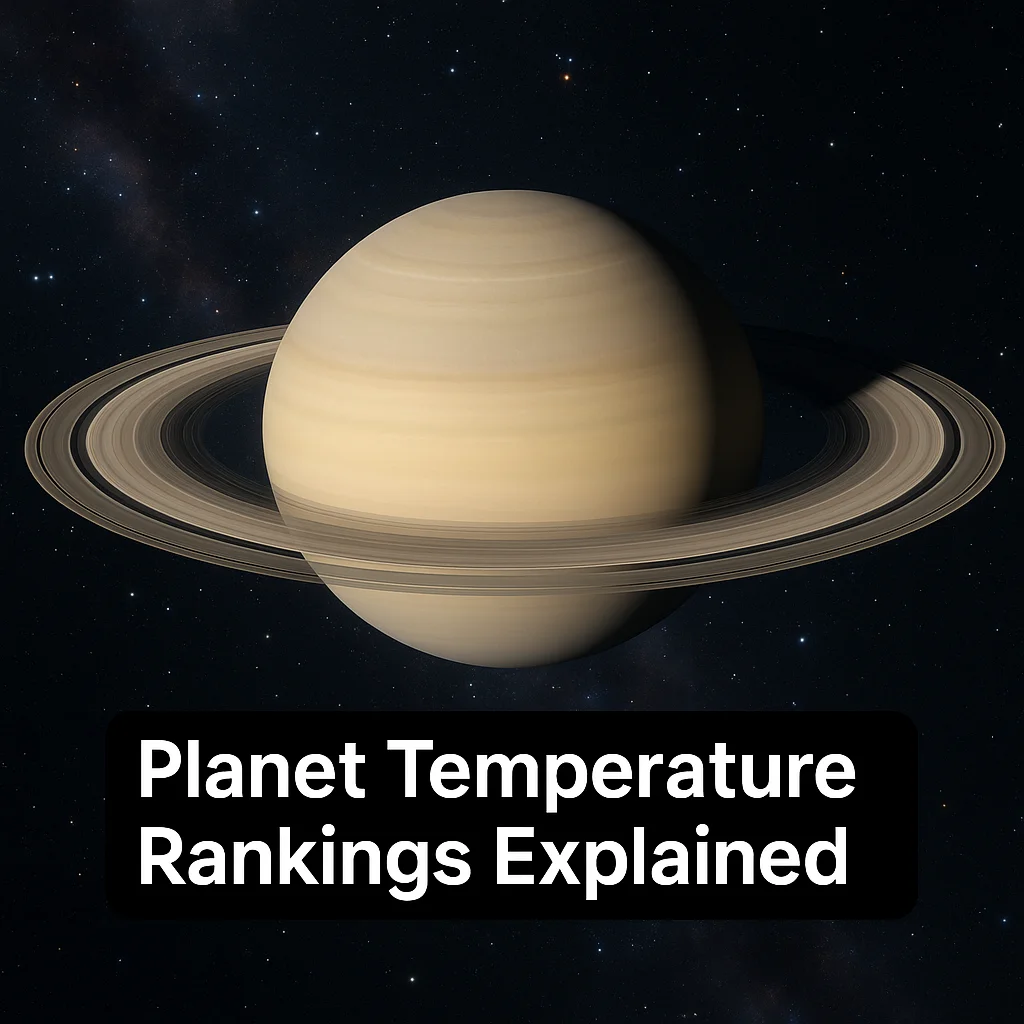
Planets are celestial bodies orbiting a star, in this case, our Sun. They can be classified as inner planets, like Mercury and Venus, which are closer to the Sun, or outer planets like Uranus and Neptune, further away. There's also a distinction between terrestrial planets which comprise solid surfaces, and gas giants which don't have a solid surface.
In this article, you will learn about the factors determining a planet's temperature, how these factors differ among the planets, and gain an understanding of the extreme environments found in our planetary neighbors.
📍 Where It Is and How Far Away
Location in the Solar System influences a planet’s exposure to sunlight and subsequently its temperature. The closer the planet is to the Sun, the more sunlight it receives. For example, Mercury is the closest planet to the Sun, whereas Neptune, much further away, receives far less solar energy.
Distances in space are often measured in Astronomical Units (AU), where 1 AU is the average distance from Earth to the Sun, approximately 93 million miles or 150 million kilometers. Planets further from the Sun receive significantly less sunlight, which cools them down.
The position also plays a huge role in determining the amount of solar energy a planet absorbs, with inner planets generally being much warmer than their distant counterparts.
🧱 Size, Mass, and Gravity (Made Simple)
Planets vary greatly in size and mass. Jupiter, the largest planet in our Solar System, has a volume large enough to hold over 1,300 Earths, while Mercury is slightly larger than Earth's Moon. These sizes affect a planet's gravity.
Gravity is the force that attracts objects towards the planet’s center. On a massive planet like Jupiter, gravity would feel much stronger, whereas on smaller planets like Mercury, it would be significantly less. However, gas giants like Jupiter don't have a solid surface, so "standing" on them isn't quite possible.
The size and mass of a planet influence its gravitational pull, impacting everything from atmospheric retention to the shape of the planet itself.
🌡️ Atmosphere and Weather
The atmosphere of a planet plays a crucial role in its temperature. Venus, for example, has a thick atmosphere composed mainly of carbon dioxide, creating a runaway greenhouse effect that makes it the hottest planet, despite not being the closest to the Sun.
Weather conditions can include extreme winds, as observed on Jupiter, or calm days seen on smaller bodies. For instance, Neptune is featured by the fastest winds in the Solar System, reaching speeds up to 1,500 miles per hour (2,400 kilometers per hour).
The composition of the atmosphere and the planet's distance from the Sun determine its weather, influencing not just temperatures but also cloud formation and weather patterns.
🪨 Surface and Interior
For rocky planets like Earth and Mars, the surface is shaped by forces like volcanism, tectonics, and impacts. Mars, for example, has the largest volcano in the Solar System, Olympus Mons.
Gas giants such as Saturn and Jupiter lack a solid surface. Instead, they have layers of gas that get denser with depth, transitioning to liquid realms and perhaps solid cores.
Understanding a planet's surface and interior helps explain its physical characteristics and behavior, whether it’s a rocky battlefield or a swirling gaseous giant.
🌀 Rotation, Orbit, and Seasons
A planet’s day is determined by its rotation period. For example, a day on Jupiter lasts about 10 hours, while Venus takes about 243 Earth days to complete one rotation, making its day longer than its year.
The orbit around the Sun defines a planet's year. Each planet’s tilt relative to its orbit affects its seasons. Earth's tilted axis leads to distinct seasons; planets with less tilt may have milder seasonal changes.
Rotation and orbit periods define how light and heat are distributed on the planet over time, causing various seasonal and diurnal temperature variations.
🧲 Magnetic Field and Radiation
A magnetic field is a protective shield generated by liquid iron moving within a planet's core, like on Earth. It protects planets from solar winds and cosmic radiation.
Strong magnetic fields can create auroras, such as those seen on Jupiter. Radiation belts, such as the Van Allen belts surrounding Earth, are regions of charged particles trapped by a planet’s magnetic field.
Magnetic fields affect spacecraft navigation and help sustain atmospheres by deflecting harmful solar radiation, crucial for planet habitability considerations.
🌙 Moons, Rings, and Neighbors
Some planets host impressive moons and rings. Saturn is famous for its stunning rings, whereas Jupiter has the largest number of moons, including volcanic Io and icy Europa.
Moons can affect tides and planet stability through gravitational interactions, as exemplified by Earth’s Moon.
Planets that lack moons or rings, such as Mercury and Venus, offer insights into planetary formation and evolutionary processes.
🔭 How We Know (Missions and Observations)
Our understanding of planets comes from both telescopic observations and space missions. Telescopes allow us to study planets from afar, capturing data on their surfaces and atmospheres.
Famous missions, like NASA’s Voyager and Curiosity on Mars, provide crucial data such as temperature readings, atmospheric content, and surface characteristics.
Data collected from these missions help scientists build models of planetary environments, expanding our knowledge of the Solar System.
❓ Common Questions and Misconceptions
Is it a star? No, planets reflect sunlight but don’t produce their own light like stars.
Can you stand on it? Only on terrestrial planets. Gas giants lack a solid surface.
Is it habitable? For now, Earth is the only planet known to support life.
Why is it that color? Atmospheric composition and sunlight scattering determine a planet’s color.
Why are some planets so cold? Distance from the Sun and lack of a warming atmosphere can cause low temperatures.
Why does Mars look red? Mars has iron oxide (rust) on its surface, giving it a red appearance.
Is there weather on Jupiter? Yes, Jupiter’s atmosphere features storms larger than Earth. The Great Red Spot is a massive storm visible for centuries.
📌 Summary
- Planet temperature rankings depend on distance from the Sun, atmosphere, and unique characteristics.
- Locations in the Solar System influence exposure to sunlight, affecting temperatures.
- Planetary size and mass determine gravity, influencing various planetary features.
- Atmosphere composition affects weather, with variations among planets.
- Rocky surfaces or atmospheric layers define a planet’s exterior and interior.
- Planet rotation and orbit influence day/night cycles and seasonal changes.
- Magnetic fields protect planets from radiation and contribute to atmospheric stability.
- Moons and rings offer insights into planetary dynamics and formation.
- Telescopes and space missions provide essential data on planetary environments.
- Understanding planets helps us unravel the Solar System’s mysteries and informs exploration efforts.