🪐 Which Planet Has the Strongest Gravity?
🌌 What It Is
Gravity is a force that attracts two bodies toward each other, and on a planetary scale, it is what keeps planets, moons, and satellites in orbit. In simple terms, gravity is what gives weight to objects and causes them to fall toward Earth's surface.
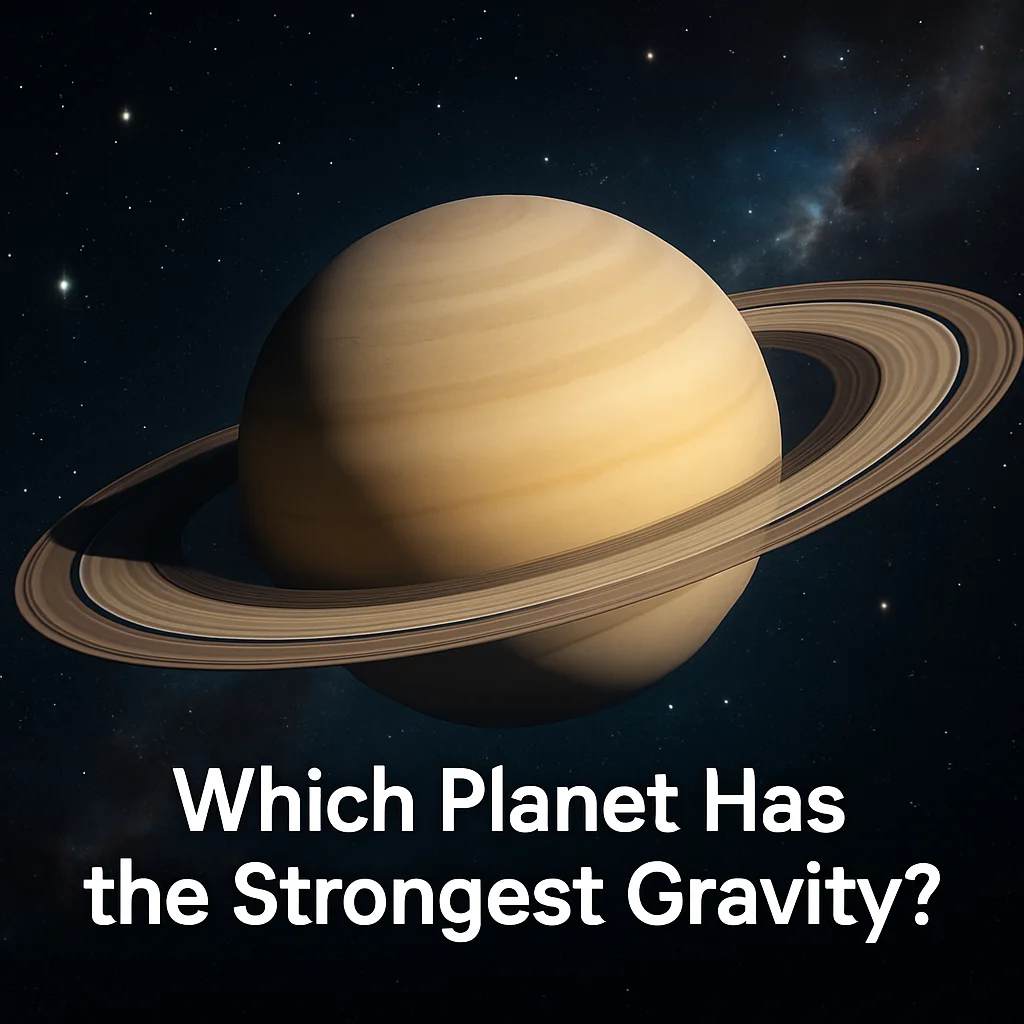
This article explores which planet in our Solar System has the strongest gravity. We will look at what makes a planet, how they are classified, and why one planet’s gravity is stronger than others. We'll also delve into various features like atmosphere, surface, and magnetic fields to understand how gravity interacts with these elements.
By the end of this exploration, you'll understand the basics of planetary gravity and how scientists study this fascinating force.
📍 Where It Is and How Far Away
The planet with the strongest gravity in our Solar System is Jupiter. Jupiter is the fifth planet from the Sun and is classified as a gas giant, along with Saturn, Uranus, and Neptune. Gas giants are large planets predominantly made of hydrogen and helium.
Jupiter is about 484 million miles away from the Sun. To put that in perspective, if the Earth is 1 Astronomical Unit (AU) from the Sun, Jupiter is about 5.2 AU away. This distance means it takes sunlight around 43 minutes to reach Jupiter, affecting its overall temperature significantly.
Located far from the Sun, Jupiter's atmosphere and surface don't receive as much solar energy as Earth, leading to colder temperatures on the planet.
🧱 Size, Mass, and Gravity (Made Simple)
Jupiter is the largest planet in our solar system. It has a diameter of about 86,881 miles, which is around 11 times larger than Earth's diameter. It also has a staggering mass, being 318 times the mass of Earth. This enormous size and mass contribute to its strong gravitational pull.
Gravity is often felt as weight, and Jupiter's gravity is about 2.4 times that of Earth's. This means that if you weigh 100 pounds on Earth, you would weigh 240 pounds on Jupiter. However, standing on Jupiter is impossible due to its lack of a solid surface.
As a gas giant, Jupiter lacks a definitive surface. The atmosphere gets denser as you go deeper until it likely becomes a liquid metallic hydrogen layer. This fluid-like layer makes standing in the traditional sense unimaginable.
🌡️ Atmosphere and Weather
Jupiter’s atmosphere is primarily composed of hydrogen and helium, much like the Sun. There are also trace amounts of other elements, but these minor components play crucial roles in its weather patterns.
Jupiter is known for its swirling clouds and massive storms, with the Great Red Spot being a notable feature. This gigantic storm has been raging for hundreds of years, measuring about 1.3 times the width of Earth.
The rapid rotation of Jupiter, completing a day in just about 10 hours, contributes to strong jet streams that create bands around the planet. These fast-moving winds drive Jupiter's complex weather system.
🪨 Surface and Interior
Unlike Earth, Jupiter doesn’t have a solid surface. Its visible atmosphere transitions into deeper layers of liquid and metallic hydrogen. These layers exist due to the immense pressure and heat within the planet.
Beneath these gaseous and liquid layers, there may be a core made of heavier elements, although its exact composition remains uncertain. Scientists suggest that the core could be rocky or icy, enveloped by a dense layer of metallic hydrogen.
This structure means that "landing" on Jupiter would be impossibly difficult, as there’s no clear surface to land on.
🌀 Rotation, Orbit, and Seasons
Jupiter rotates extremely quickly, taking just under 10 hours to complete one turn, making it the fastest rotating planet in our Solar System. This rapid rotation causes an equatorial bulge due to centrifugal forces pulling the planet outward.
Jupiter takes about 12 Earth years to orbit the Sun once. Its axis tilt is minimal, just about 3 degrees, meaning Jupiter doesn't experience significant seasonal changes like Earth does.
This stable tilt keeps Jupiter's weather patterns relatively constant, dominated more by its fast rotation than by axial tilt.
🧲 Magnetic Field and Radiation
Jupiter has an extraordinarily powerful magnetic field, the strongest of any planet in our Solar System. It's about 14 times stronger than Earth's magnetic field.
This magnetic field traps particles from the solar wind, creating intense radiation belts around the planet. These radiation belts can pose challenges for spacecraft and lead to beautiful auroras at Jupiter’s poles.
The magnetic field is thought to be generated by the movement of metallic hydrogen inside Jupiter, making it a subject of great interest for scientists studying planetary magnetism.
🌙 Moons, Rings, and Neighbors
Jupiter hosts a diverse and fascinating celestial neighborhood with at least 79 known moons, including the four large Galilean moons: Io, Europa, Ganymede, and Callisto. Each of these moons offers unique features and has been the focus of extensive scientific study.
Ganymede is the largest moon in the Solar System, even bigger than the planet Mercury. Europa is considered a prime candidate for harboring extraterrestrial life due to its subsurface ocean.
Jupiter also has faint rings made of dust particles thrown up by meteor impacts on its moons. While not as prominent as Saturn's rings, they add to Jupiter's complex system.
🔭 How We Know (Missions and Observations)
Our understanding of Jupiter has come from a combination of telescopic observations and spacecraft missions. Earth-based telescopes provide critical long-term monitoring, while missions like Pioneer, Voyager, and Galileo have made close-up studies.
The Juno mission, launched by NASA, has been particularly enlightening, offering detailed measurements of Jupiter’s atmosphere, magnetic field, and more. These missions collect data through various instruments, producing images, spectra, and readings of gravitational and magnetic fields.
Such observations help scientists build models of Jupiter, studying its formation, evolution, and the fascinating dynamics of this gas giant.
❓ Common Questions and Misconceptions
Is Jupiter a star? Although Jupiter is massive and made mostly of hydrogen and helium, it lacks the necessary mass to ignite nuclear fusion and become a star.
Can you stand on Jupiter? No, Jupiter has no solid surface; trying to stand would mean sinking into its dense atmosphere.
Is Jupiter habitable? Jupiter itself is inhospitable due to its harsh conditions, but some of its moons, like Europa, may have potential for life.
Why does Jupiter have stripes? The alternating bands are created by high-speed winds and differing chemical compositions in its atmosphere.
What causes Jupiter's auroras? Jupiter’s strong magnetic field interacts with charged particles to create spectacular auroras at its poles.
Does Jupiter have rings? Yes, but they are faint and made mostly of dust particles.
Why is Jupiter so colorful? The colors result from different elements in its upper atmosphere, affected by sunlight and Jupiter’s chemistry.
📌 Summary
- Jupiter is the planet with the strongest gravity in the Solar System.
- Located as the fifth planet from the Sun, it’s a gas giant.
- Jupiter is massive and large, contributing greatly to its gravity.
- Its atmosphere mostly contains hydrogen and helium, with powerful storms.
- It's a gas giant, lacking a solid surface, with a possible rocky core.
- Jupiter rotates quickly, leading to powerful winds and banding.
- It has a strong magnetic field, affecting space weather and radiation.
- Famous for its many moons, including the Galilean moons, and faint rings.
- Knowledge from telescopes and spacecraft missions informs our understanding.
- Jupiter's immense size and distinctive features make it a fascinating subject.