🪐 Which Planet Spins the Fastest?
🌌 What It Is
When we think of planets in our Solar System, we often picture them orbiting around the Sun in a grand cosmic dance. But these planets are also spinning around their own axes. Our planet Earth spins, which gives us day and night, but each planet spins at its own unique speed. The planet that spins the fastest is Jupiter.
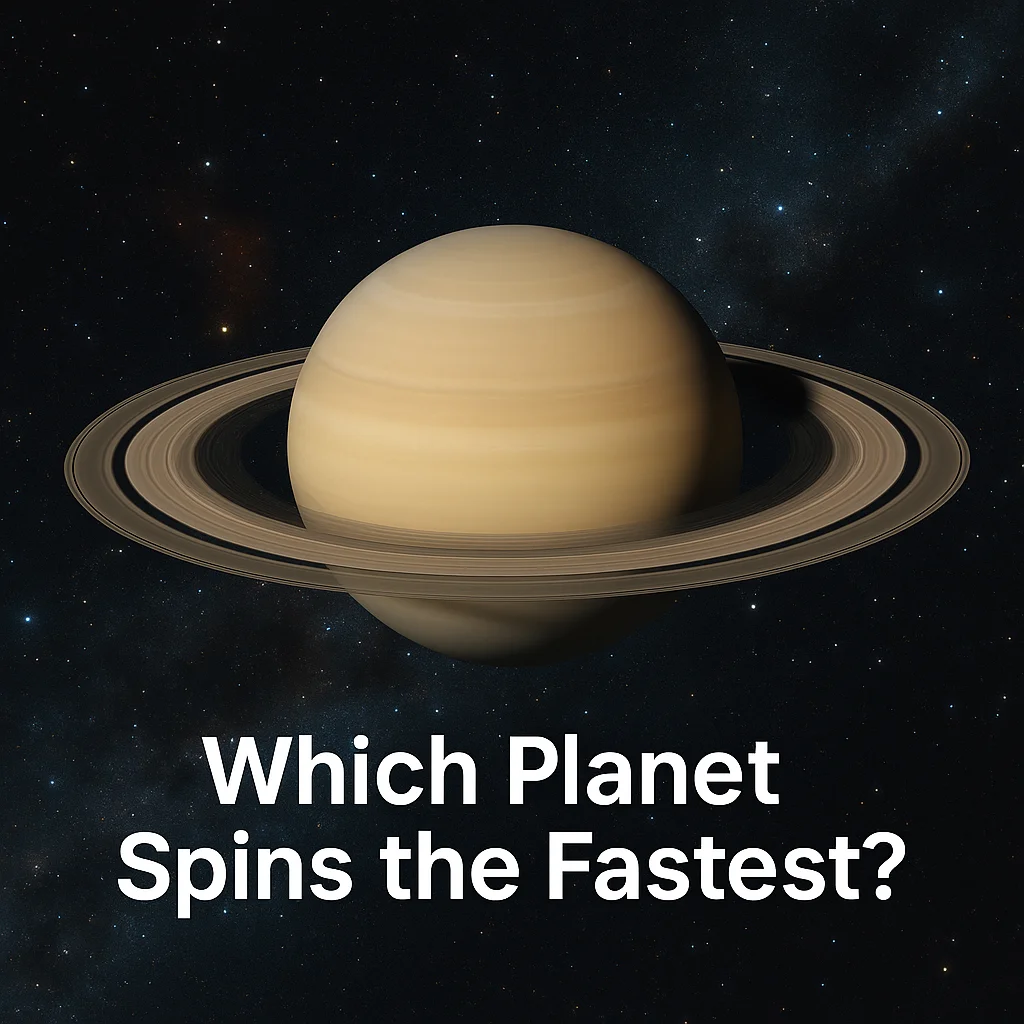
Jupiter is classified as a gas giant, a type of planet that is much larger than terrestrial planets like Earth and is composed mostly of hydrogen and helium. It doesn't have a solid surface like Earth; instead, it's more like a gigantic ball of gas with layers.
In this article, we'll explore what makes Jupiter the fastest spinning planet, and what this means for its characteristics, its atmosphere, and more. By understanding its rapid rotation, we can learn more about this fascinating giant of the Solar System.
📍 Where It Is and How Far Away
Jupiter is the fifth planet from the Sun. It orbits at an average distance of about 5.2 astronomical units (AU). One astronomical unit is the average distance from Earth to the Sun, approximately 93 million miles or 150 million kilometers. This means Jupiter is about 484 million miles or 778 million kilometers away from the Sun.
Because of its distance from the Sun, Jupiter receives far less sunlight than Earth does. This results in a much lower average temperature compared to our planet, although its thick atmosphere and rapid rotation create its own unique climate.
The position of Jupiter in the Solar System means it takes about 12 Earth years to complete one orbit around the Sun. It's visible from Earth because of its size, being one of the brightest objects in the night sky.
🧱 Size, Mass, and Gravity (Made Simple)
Jupiter is the largest planet in our Solar System, with a diameter of around 86,881 miles or 139,822 kilometers. To visualize this, you could fit all the other planets in the Solar System inside Jupiter and still have space left. Its mass is so immense that it has over 300 times the mass of Earth.
The gravity on Jupiter is much stronger than on Earth due to its massive size. If you could stand on a solid surface at the top of its clouds, you would feel more than twice the weight you do on Earth. However, because Jupiter doesn't have a solid surface, this is a purely hypothetical scenario.
Instead of a surface, Jupiter has a powerful gravitational pull that affects its many moons and rings, as well as everything in its vicinity, including asteroids and even other planets, with its strong gravitational forces.
🌡️ Atmosphere and Weather
Jupiter's atmosphere is primarily made of hydrogen and helium, much like the Sun. Its thick atmosphere gives rise to complex weather patterns that include massive storms, swirling clouds, and fast-moving winds.
One of the most recognizable features of Jupiter is the Great Red Spot, a gigantic storm larger than Earth that has been raging for at least 300 years. This storm is easily visible when looking at Jupiter's full disk.
The weather on Jupiter is driven by its rapid rotation and the heat generated from its core, leading to dynamic and sometimes violent atmospheric phenomena. The winds on Jupiter can reach speeds of more than 300 miles per hour, far exceeding those on Earth.
🪨 Surface and Interior
Jupiter doesn't have a solid surface like Earth. Instead, it's a massive sphere of gas with a possible core made of rock and metal, although this core is surrounded by a thick layer of metallic hydrogen. Around this is a layer of hydrogen and helium in gaseous form.
The surface we can see through telescopes or spacecraft imagery is actually the tops of its clouds, which can exhibit a variety of colors depending on the chemicals present. Clouds of ammonia and water ice, along with traces of other compounds, create the banded appearance visible across its full disk.
Inside, the layers are less clearly defined than Earth's, but the pressure and temperature increase dramatically as you move towards the core, possibly reaching conditions that resemble a solid center.
🌀 Rotation, Orbit, and Seasons
Jupiter's rotation is remarkably fast, completing one spin approximately every 10 hours. This rapid rotation is the fastest of any planet in our Solar System, leading to a unique shape that is slightly flattened at the poles and bulging at the equator.
Due to this swift rotation, weather systems on Jupiter are incredibly complex. Despite its fast spin, Jupiter's orbit around the Sun is much slower, taking about 12 Earth years to complete one revolution.
Jupiter's axial tilt is only about 3 degrees, which means it does not have significant seasonal changes like Earth does. Its consistent tilt results in a more uniform climate year-round.
🧲 Magnetic Field and Radiation
Jupiter has an extremely strong magnetic field, much stronger than Earth's. This magnetic field is created by the movement of metallic hydrogen inside the planet, and it generates intense radiation belts surrounding Jupiter.
The magnetic field protects its atmosphere from the solar wind and creates spectacular auroras at its poles, similar to Earth's northern and southern lights but much stronger.
The presence of this magnetic field and the intense radiation make it challenging for spacecraft to operate near Jupiter for long periods without advanced shielding.
🌙 Moons, Rings, and Neighbors
Jupiter has an extensive system of moons, with more than 75 confirmed to date. The four largest moons, known as the Galilean moons—Io, Europa, Ganymede, and Callisto—are among the largest in the Solar System and can be seen from Earth with a good telescope.
These moons have interesting characteristics of their own, such as volcanic activity on Io and the possibility of an ocean beneath Europa's icy surface. The gravitational interaction between Jupiter and its moons significantly affects their orbits and causes tidal heating in some cases.
Jupiter also has a faint ring system composed mainly of dust particles. While not as prominent as Saturn's rings, they are another feature that enhances Jupiter's complexity in space.
🔭 How We Know (Missions and Observations)
Much of what we know about Jupiter comes from both ground-based telescopes and space missions. Observations of Jupiter have been recorded since ancient times, but significant understanding has come with modern technology.
Notable spacecraft missions such as Pioneer 10, Voyager 1 and 2, and the more recent Juno mission have provided invaluable data. These missions collect various types of data, including images, spectroscopic readings, and measurements of Jupiter's magnetic field and gravity.
The telescopes allow scientists to observe changes in Jupiter's atmosphere and track storms and cloud movements, while spacecraft provide a closer, more detailed view, improving our understanding of this giant planet.
❓ Common Questions and Misconceptions
Is Jupiter a star? No, Jupiter is not a star. Although it is made mostly of hydrogen and helium, it doesn't have enough mass to initiate nuclear fusion and become a true star.
Can you stand on Jupiter? No, you cannot stand on Jupiter. It's a gas giant with no solid surface, and its atmosphere transitions into deeper layers of gas and liquid under high pressure.
Is Jupiter habitable? Jupiter itself is not habitable, as it lacks a solid surface and has harsh atmospheric conditions; however, some of its moons may hold the potential for life.
Why is it so colorful? Jupiter's colorful appearance comes from different gases in its atmosphere, which create bands and clouds of varying shades due to chemical reactions and differences in temperature.
Does it have a lot of moons? Yes, Jupiter has an extensive system of moons, including many small ones and four large ones that are of particular interest to scientists.
Does it have rings like Saturn? Yes, although not as visible as Saturn's, Jupiter has a faint ring system made of dust particles.
Is its day really short? Yes, its day is shorter than on Earth, lasting only about 10 hours due to its fast rotation.
📌 Summary
- Jupiter is the fastest spinning planet in the Solar System.
- Located as the fifth planet from the Sun, it's about 5.2 AU away.
- Huge size and mass with a strong gravitational force but no solid surface.
- Dynamic atmosphere with massive storms, like the Great Red Spot.
- No clear surface; composed mainly of gas with a possible solid core.
- Rapid rotation, taking only 10 hours to complete a day.
- Strong magnetic field creating intense radiation belts and auroras.
- Over 75 moons, including prominent ones like the Galilean moons, and faint rings.
- Understanding from both telescopic and space mission observations.
- A memorable fact: If it were more massive, Jupiter might have become a star!