🪐 Why Jupiter Is So Massive
🌌 What It Is
Jupiter is the largest planet in our Solar System, known as a gas giant. This means it's primarily made of gases rather than having a solid surface like Earth. Along with Saturn, Uranus, and Neptune, Jupiter makes up the outer planets and is classified as a gas giant due to its composition and size.
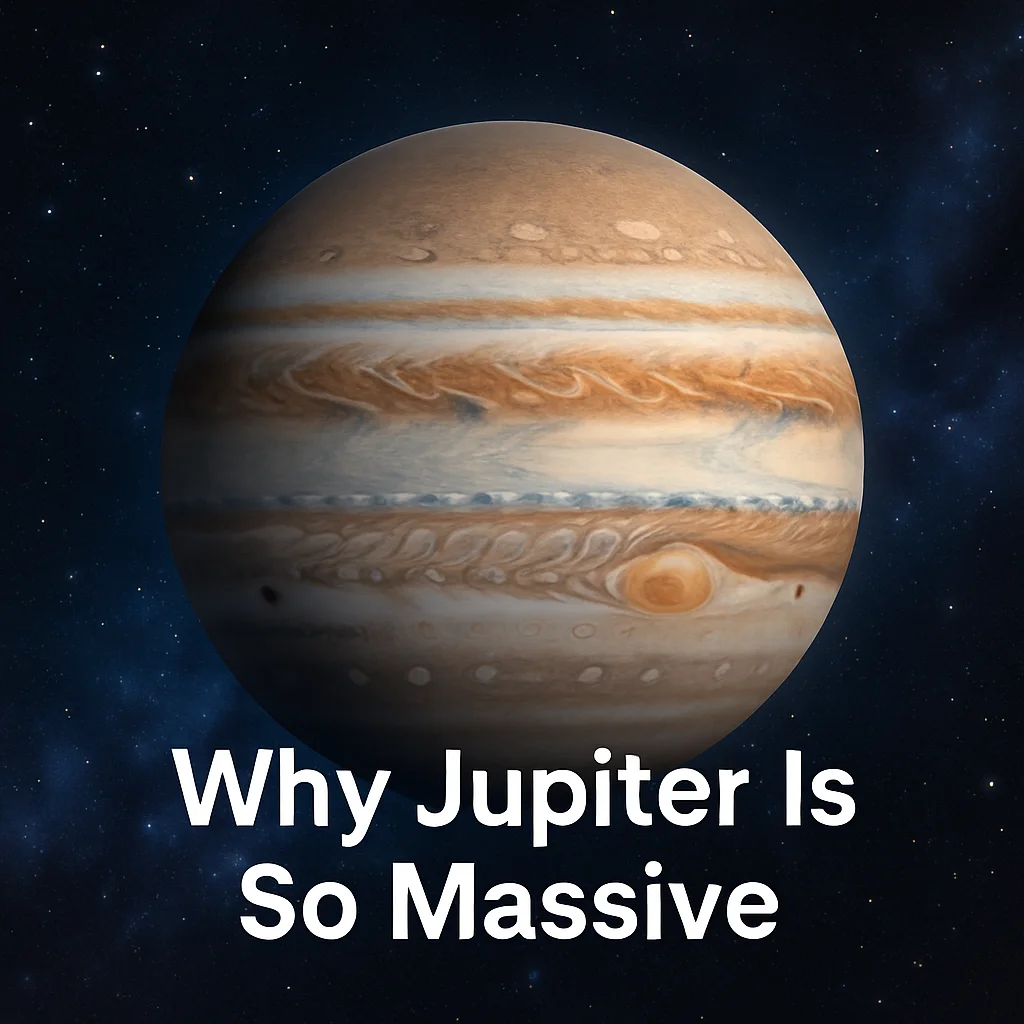
In this article, you will learn why Jupiter is so massive compared to other planets, exploring its composition, gravitational influence, and more. We'll delve into its atmosphere, interior structure, and even its magnetic field.
Understanding what makes Jupiter so enormous helps us appreciate the diverse nature of planets in our Solar System. From its swirling stormy atmosphere to its vast array of moons, Jupiter is a fascinating subject of study.
📍 Where It Is and How Far Away
Jupiter is the fifth planet from the Sun, situated between Mars and Saturn. It orbits at an average distance of about 484 million miles or 778 million kilometers from the Sun. This vast distance means Jupiter receives significantly less sunlight than Earth, affecting its temperatures and atmosphere.
To put this into perspective, Jupiter is roughly 5.2 astronomical units (AU) from the Sun. An astronomical unit is a measurement based on the average distance from the Earth to the Sun, roughly 93 million miles or 150 million kilometers.
Because of its distance from the Sun, Jupiter's temperatures are much colder, which significantly contributes to its atmospheric conditions and the prevalence of storms and clouds.
🧱 Size, Mass, and Gravity (Made Simple)
Jupiter is the largest planet in our Solar System, with a diameter of approximately 86,881 miles or 139,822 kilometers. To visualize this, if Earth were the size of a nickel, Jupiter would be about as big as a basketball. Its immense size accounts for its massive gravitational pull.
Despite having no solid surface, Jupiter's gravity is more than twice as strong as Earth's. If you could stand on Jupiter (which you can't, because it's gaseous), you would feel much heavier than you do on Earth, over double your weight here.
This immense mass and gravity also allow Jupiter to influence objects around it, including its many moons and even asteroids, making it a dominant force in the Solar System.
🌡️ Atmosphere and Weather
Jupiter's atmosphere is composed mainly of hydrogen and helium, with traces of methane, water vapor, ammonia, and other compounds. The planet is known for its vibrant cloud bands, ranging from white to orange to brown, which are created by complex chemical reactions and rapid rotation.
The planet's atmosphere is home to powerful storms, the most famous being the Great Red Spot, a giant storm that has raged for at least 350 years. These storms are driven by the heat from Jupiter's interior and its rapid rotation.
Jupiter's weather is extreme, with winds reaching up to 384 miles per hour (618 kilometers per hour), far surpassing any hurricane on Earth. The combination of solar heat, rapid rotation, and internal heat sources keeps its atmosphere ever-churning.
🪨 Surface and Interior
Unlike terrestrial planets, Jupiter does not have a well-defined solid surface. Instead, as you descend through its atmosphere, gases gradually compress into a liquid and possibly even metallic hydrogen, surrounding a core that might be rocky or icy.
The interior structure of Jupiter includes several layers, transitioning from gaseous to liquid as pressure increases. The core is significantly heated, contributing to Jupiter's intense internal heat, and remains largely mysterious to scientists.
This lack of a clear surface makes Jupiter unique among the planets, and understanding its interior provides insights into its magnetic field and overall dynamics.
🌀 Rotation, Orbit, and Seasons
Jupiter has a rapid rotation period, completing a full spin on its axis in just under 10 hours, making it the fastest rotating planet in the Solar System. This fast rotation contributes to its distinct equatorial bulge and strong atmospheric currents.
Orbiting the Sun every 11.86 Earth years, Jupiter's year is lengthy compared to our own. Its axial tilt is only about 3 degrees, so it experiences minimal seasonal changes compared to Earth.
This rapid rotation and slight tilt significantly influence the planet's weather patterns and contribute to the dynamic appearance of its cloud bands.
🧲 Magnetic Field and Radiation
Jupiter's magnetic field is the strongest of any planet in the Solar System, over 20,000 times stronger than Earth's. This massive field is generated by the movement of metallic hydrogen within its interior, possibly generating a powerful dynamo effect.
This magnetic field traps particles, creating intense radiation belts around the planet. These belts can be hazardous to spacecraft, requiring special shielding for missions exploring the Jovian system.
Jupiter's powerful magnetic field also leads to spectacular auroras at its poles, far more intense than those on Earth, providing stunning displays captured by telescopes and spacecraft alike.
🌙 Moons, Rings, and Neighbors
Jupiter is host to a large family of moons, with at least 79 moons orbiting it, including the four large Galilean moons: Io, Europa, Ganymede, and Callisto. These moons are fascinating in their own right, with some potentially harboring subsurface oceans.
The planet also has faint rings, unlike Saturn's, which are composed of small dust particles from meteoroid impacts on its moons. Though faint, these rings are yet another aspect of Jupiter's complex system.
Jupiter's strong gravity influences the motion of many asteroids in the Solar System, maintaining the asteroid belt's position and protecting the inner planets from frequent impacts.
🔭 How We Know (Missions and Observations)
Our understanding of Jupiter comes from both telescopic observations from Earth and data gathered by spacecraft. Telescopes can provide images and spectra, while spacecraft such as NASA's Juno mission deliver in-depth measurements of Jupiter's atmosphere, magnetic field, and gravity.
Previous missions, like the Galileo spacecraft, have provided insights into Jupiter's moons and surface conditions, and each mission contributes to our growing knowledge of this gas giant.
These observations and measurements have revealed much about Jupiter's composition, dynamic weather systems, and magnetic environment, helping piece together the planet's complex picture.
❓ Common Questions and Misconceptions
Is Jupiter a star? No, Jupiter is not a star, though it is mostly composed of hydrogen and helium like a star. It lacks the mass needed to ignite nuclear fusion.
Can you stand on Jupiter? No, Jupiter has no solid surface. Its gaseous composition means there is no ground to stand on.
Is Jupiter habitable? Not for human-like life, due to its gaseous composition, lack of surface, and extreme conditions.
Why is Jupiter that color? Its colorful bands are caused by different chemical compositions and temperatures in its clouds.
Does it rain on Jupiter? Jupiter's atmosphere includes water and other compounds that can form precipitation, but its effects are unlike Earth's rain.
Is Jupiter getting bigger? Jupiter's mass remains relatively constant, though it may still be cooling and contracting slightly over time.
📌 Summary
- Jupiter is a gas giant, the largest planet in the Solar System.
- It orbits the Sun at about 5.2 AU, much farther than Earth.
- Jupiter's massive size gives it a powerful gravitational pull.
- The atmosphere is composed mainly of hydrogen and helium with massive storms.
- Jupiter has no solid surface; its interior is largely gaseous and liquid.
- It rotates rapidly, completing a day in just under 10 hours.
- Jupiter has a powerful magnetic field with strong radiation belts.
- It has many moons, including the notable Galilean moons, and faint rings.
- Our knowledge comes from telescopes and missions like Juno.
- The Great Red Spot is a long-lived storm, part of Jupiter's dynamic weather system.