🪐 How Planets Form: A Simple Guide
🌌 What It Is
Planets are celestial bodies that orbit stars. Unlike stars, they do not emit their own light but reflect the light from their parent star. To be classified as a planet, an object must meet certain criteria: it must orbit the Sun, have enough gravity to pull itself into a roughly spherical shape, and have cleared its orbit of other debris.
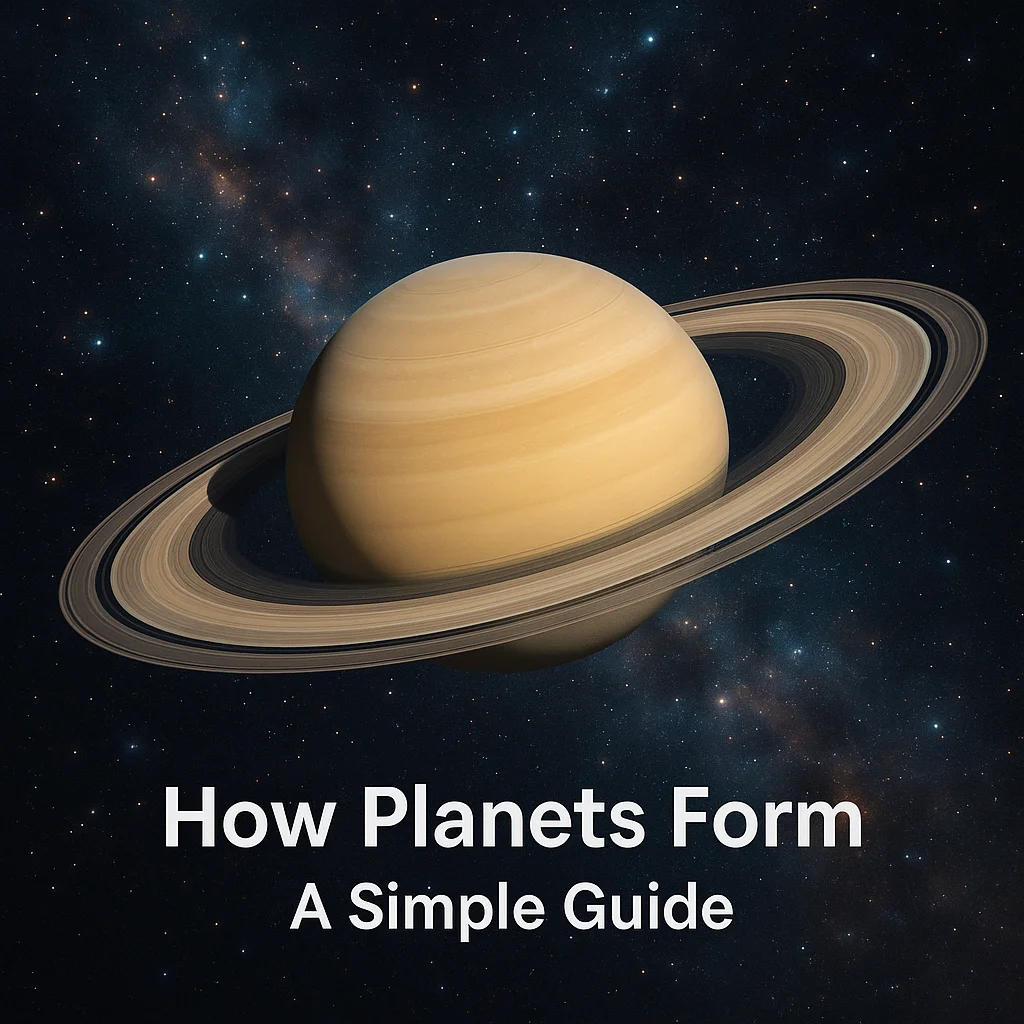
In our Solar System, planets are divided into two main categories: the inner, rocky planets—Mercury, Venus, Earth, and Mars—and the outer, gas and ice giants—Jupiter, Saturn, Uranus, and Neptune. This guide will help you understand the fascinating process behind the formation of these planets.
The journey into planet formation will cover how dust and gas interact, the stages of growth from micro to massive, and what determines a planet's final structure.
📍 Where It Is and How Far Away
Planets are located within star systems. Our Solar System is part of the Milky Way galaxy, and the planets orbit our star, the Sun. These range from Mercury, the closest to the Sun, to Neptune, the farthest. The distance of each planet from the Sun affects its conditions, such as light and temperature.
Astronomers use units like astronomical units (AU) to describe distances in the Solar System. One AU is the average distance from Earth to the Sun, roughly 93 million miles or 150 million kilometers. For instance, Jupiter is about 5 AU from the Sun, meaning it's five times farther out than Earth.
The distance affects the amount of sunlight a planet receives, influencing its temperature and climate. Inner planets are generally warmer due to their proximity to the Sun, whereas outer planets, farther away, remain cold.
🧱 Size, Mass, and Gravity (Made Simple)
Planets vary widely in size and mass, from tiny Mercury to massive Jupiter. Size refers to the diameter of the planet, while mass is a measure of how much material the planet contains. Jupiter, for example, is the largest planet in our Solar System and has the highest mass, which gives it strong gravity.
Gravity on a planet’s surface determines how heavy things "feel". On Earth, gravity gives us our sense of weight. On a massive planet like Jupiter, you would feel much heavier, assuming you could stand on it, which you can't since it’s a gas giant without a solid surface.
Understanding the size and mass of a planet helps determine its ability to hold onto an atmosphere, affect surface conditions, and potentially support life.
🌡️ Atmosphere and Weather
A planet’s atmosphere is the layer of gases surrounding it. The composition and density of an atmosphere can vary greatly between planets. Earth’s atmosphere, rich in oxygen and nitrogen, supports life, while Venus has a thick, toxic atmosphere of carbon dioxide.
Weather patterns on planets are influenced by their atmospheres and other factors like rotation speed and solar energy. Jupiter's Great Red Spot is a giant storm persisting for centuries due to the planet's rapid rotation and atmospheric composition.
The presence of clouds, strong winds, and storm systems is common in planetary atmospheres, with each planet exhibiting weather according to its unique environmental conditions.
🪨 Surface and Interior
Rocky planets like Earth and Mars have solid surfaces marked by features like craters, mountains, and valleys. These features are shaped by various processes, such as volcanism and tectonic activity.
Gas giants like Jupiter do not have a true surface. Instead, they have layers of clouds and gas that get denser towards the core. Beneath these clouds, the pressure and temperature rise sharply.
The interior of a planet includes its core, typically composed of metal, and layers like the mantle and crust. These help scientists understand the planet’s formation and geological activity.
🌀 Rotation, Orbit, and Seasons
Planetary rotation is the spinning of a planet around its axis. A complete rotation defines the length of a day on that planet. For instance, Jupiter has a rapid rotation period of just about 10 hours.
The orbit is the planet's path around the Sun, determining the length of its year. Earth takes about 365 days to orbit the Sun, while Neptune takes 165 Earth years due to its greater distance.
Axial tilt affects a planet's seasons. Earth’s tilt leads to the changing seasons, while Uranus’s extreme tilt causes unusual seasonal changes.
🧲 Magnetic Field and Radiation
A magnetic field is a region around a planet where magnetic forces can be detected. Many planets, like Earth and Jupiter, have strong magnetic fields that protect them from harmful solar radiation.
This field can create beautiful natural phenomena like auroras, which occur when solar particles interact with atmospheric gases near the magnetic poles.
The study of magnetic fields helps scientists understand space weather and its impact on satellites and potentially habitable conditions on other planets.
🌙 Moons, Rings, and Neighbors
Planets can have moons, which are natural satellites orbiting the planet. Earth has one moon, while Jupiter and Saturn have many. These moons vary in size and can greatly affect their parent planet’s gravitational dynamics.
Some planets, like Saturn, are known for their spectacular ring systems. These rings consist of ice, rock, and dust particles forming a flat, thin disk that encircles the planet.
The presence or absence of moons and rings adds complexity to the planet’s environment and often provides important clues about its history.
🔭 How We Know (Missions and Observations)
Astronomers use telescopes and spacecraft to study planets. Telescopes, both on the ground and in space, can capture images and spectra, providing invaluable data about the planets and their composition.
Space missions, such as the Voyager and Galileo probes, reveal details that telescopes alone cannot, such as measurements of magnetic fields, atmospheric samples, and imaging from space.
These missions send back data that help us understand planets more deeply, including their weather, atmosphere, and potential for life.
❓ Common Questions and Misconceptions
Is a planet a star? No, planets do not produce their own light; they reflect the light from their stars.
Can you stand on a gas giant? No, gas giants don’t have solid surfaces to stand on.
Is it habitable? Habitable planets require conditions like those on Earth—liquid water, suitable atmosphere—rare in our Solar System.
Why is Jupiter so big? Jupiter's large mass is due to its composition and the availability of gases in the early Solar System.
Are the rings solid? No, planetary rings are made of countless small particles of ice and rock.
How do scientists measure distance to planets? Astronomers use units like astronomical units and light years to measure distances in space.
📌 Summary
- Planets are celestial entities that orbit stars and differ from stars by reflecting light.
- They are located within solar systems, influenced by proximity to their star.
- Varied in size and mass, planets have distinct surface gravity and composition.
- Atmospheres range from thick and toxic to thin and supportive of life.
- Surfaces vary with rocky features on terrestrial planets and gaseous layers on giants.
- Rotation affects day length, and orbit defines year length, with tilt influencing seasons.
- Magnetic fields protect planets from solar winds and give rise to auroras.
- Moons and ring systems vary, contributing to each planet's unique characteristics.
- Telescopic observations and spacecraft missions greatly enhance our understanding.
- Understanding planets is a rich field combining astronomy, geology, and physics.