🪐 Retrograde Rotation Explained (Venus & More)
🌌 What It Is
Retrograde rotation refers to a celestial object's rotation that is opposite to the rotation direction of most objects in its system. In our Solar System, this phenomenon is particularly interesting when considering planets like Venus and Uranus. While most planets rotate on their axis in the same direction they orbit the Sun, these planets exhibit unique rotational characteristics.
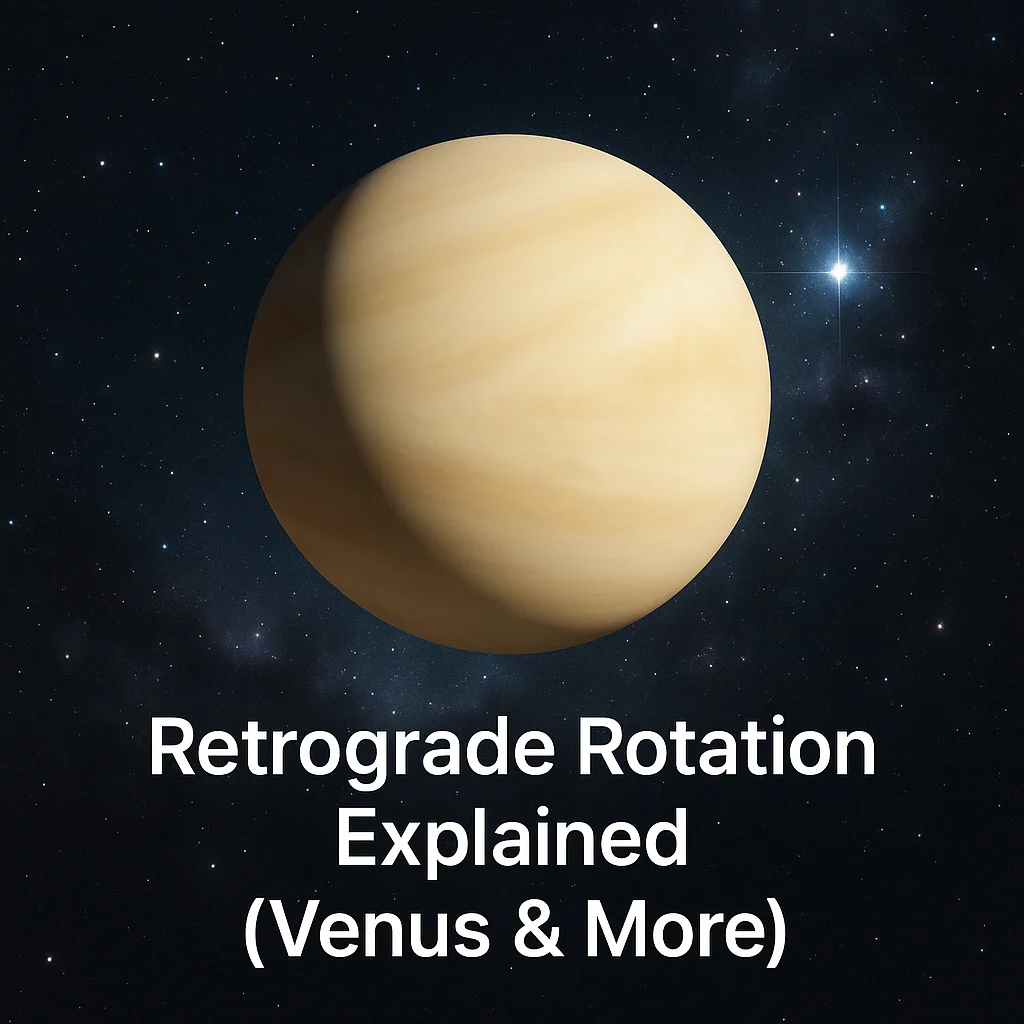
Venus rotates in the opposite direction of its orbit around the Sun, known as retrograde rotation. This means if you were standing on its surface, the Sun would rise in the west and set in the east. This is in stark contrast to Earth and the majority of planets where the opposite is true. In this article, we will explore what retrograde rotation is, why it occurs, and the implications for planets like Venus.
Understanding retrograde rotation offers insights into planetary formation and dynamics, enriching our knowledge of the complex movements within the Solar System. Readers will learn about how this backward spin affects the planet's day length, climate, and more.
📍 Where It Is and How Far Away
Venus is the second planet from the Sun, located between Mercury and Earth. It is one of the inner planets of our Solar System and is classified as a terrestrial planet due to its rocky composition. Venus is often visible from Earth as the brightest object in our night sky after the Sun and Moon.
The average distance from the Sun to Venus is about 67 million miles (approximately 108 million kilometers), or roughly 0.7 Astronomical Units (AU). An Astronomical Unit is the average distance from the Earth to the Sun, about 93 million miles. This relative proximity makes Venus an intriguing subject for observation and study.
The position of Venus in the Solar System significantly influences its temperature. With its thick atmosphere and close proximity to the Sun, Venus experiences extreme surface temperatures that exceed those of Mercury, despite being farther from the Sun.
🧱 Size, Mass, and Gravity (Made Simple)
Venus has a diameter of about 7,520 miles (around 12,104 kilometers), making it similar in size to Earth. Because of this, Venus is often dubbed Earth's "sister planet." However, despite their similar sizes, there are stark differences in their compositions and environments.
The mass of Venus is approximately 81.5% that of Earth. This means that gravity on Venus is a bit weaker than on Earth. If you weigh 100 pounds on Earth, you would weigh about 91 pounds on Venus. This slight difference in gravity is due to its mass and size.
There is no solid surface to stand on Venus due to its thick, gaseous atmosphere and harsh surface conditions. Yet, the concept of gravity allows us to estimate what a human would weigh if they could stand there.
🌡️ Atmosphere and Weather
Venus has a thick atmosphere composed primarily of carbon dioxide, with clouds of sulfuric acid. This dense atmosphere creates a runaway greenhouse effect, trapping heat and leading to surface temperatures hotter than those of Mercury.
Clouds on Venus are incredibly thick, preventing sunlight from reaching the planet's surface and creating constant overcast skies. Wind speeds can reach up to 225 miles per hour (360 kilometers per hour) in the upper atmosphere, enough to send the thick clouds moving rapidly around the planet.
The heat, combined with the pressure on the surface (over 90 times that of Earth), contributes to a hostile environment where liquid water cannot exist, and metals like lead could melt.
🪨 Surface and Interior
The surface of Venus is rocky, with vast volcanic plains, mountains, and numerous craters. Its landscape is shaped by extensive volcanic activity, though it's unclear if any volcanoes are currently active.
Beneath the surface, Venus is believed to have a core, mantle, and crust, much like Earth. However, the thick atmosphere and high pressures make it difficult to study these layers directly.
The lack of water and extreme conditions limit surface erosion, allowing impact craters to remain unchanged for long periods.
🌀 Rotation, Orbit, and Seasons
Venus has a very slow rotation, taking about 243 Earth days to complete a single rotation on its axis, making a Venusian day longer than its year. A year on Venus is about 225 Earth days. Because of its retrograde rotation, the Sun appears to rise in the west and set in the east.
The axial tilt of Venus is minimal, about 3 degrees, which means it experiences no significant seasonal changes. This is unlike Earth, where the tilt of approximately 23.5 degrees leads to the changing seasons.
Retrograde rotation remains a subject of study, with theories suggesting it could be due to a massive collision or gravitational interactions during its formation.
🧲 Magnetic Field and Radiation
Venus has a weak magnetic field compared to Earth, whose strong magnetic field is powered by its molten iron core. The absence of a significant magnetic field means Venus is more exposed to solar winds, which the atmosphere largely shields.
The weak field and interaction with solar winds create an induced magnetosphere—a region where charged particles are deflected—around the planet. Unlike Earth, Venus does not experience auroras because of this weak magnetic presence.
Radiation on Venus is significantly less impactful at the surface because the thick atmosphere absorbs much of the radiation from solar winds.
🌙 Moons, Rings, and Neighbors
Interestingly, Venus has no moons or ring systems. This absence makes it unique among the planets closer to the Sun. One theory for the lack of moons is related to its retrograde rotation and past gravitational interactions that might have ejected potential moons into space.
While Venus has no natural satellites, its neighbors, including Earth and Mars, and its regular movements through the heavens have been studied extensively due to their impacts on our understanding of the Solar System.
🔭 How We Know (Missions and Observations)
Our understanding of Venus has been greatly informed by both ground-based telescopes and spacecraft missions. Telescopes have been able to track its bright glow in the sky for centuries, but spacecraft provide a closer look.
Notable missions include NASA's Magellan, which mapped the surface using radar, and the Soviet Union's Venera program, which landed probes on the surface. These missions collected data on Venus's composition, atmosphere, and geology.
Current missions continue to study Venus, focusing on its atmosphere and potential volcanic activity, and new missions are in the works to further investigate the dynamics of its retrograde rotation.
❓ Common Questions and Misconceptions
Is Venus a star? No, Venus is a planet and the brightest after the Sun and the Moon in Earth's sky.
Can you stand on Venus? Not feasibly, due to extreme temperatures and crushing atmospheric pressure.
Is Venus habitable? No, the conditions are too harsh for life as we know it.
Why is Venus so bright? Its thick clouds reflect a lot of sunlight, making it very bright.
Is Venus's retrograde rotation unique? While rare, Uranus also rotates on its side, exhibiting unusual rotation.
Why does Venus rotate backward? Scientists think it could be due to past impacts or gravitational interactions.
📌 Summary
- Retrograde rotation: Venus rotates opposite its orbit direction.
- Located between Mercury and Earth.
- Similar in size to Earth but with distinct differences.
- Dense CO₂ atmosphere creates extreme greenhouse effect.
- Rocky surface with volcanic features.
- Long day (243 Earth days) and short year (225 Earth days).
- Weak magnetic field but dense atmosphere reduces radiation impact.
- No moons or rings; isolation is intriguing for scientists.
- Studied via telescopes and spacecraft, like Magellan and Venera.
- Memorable fact: Despite being farther from the Sun, it's hotter than Mercury.