🪐 Why Some Planets Have Rings
🌌 What It Is
Some planets in our solar system have fascinating features known as rings. These rings are composed mainly of ice particles, alongside smaller amounts of rock and dust. In simple terms, a planet is a celestial body that orbits the sun and has sufficient mass for its self-gravity to overcome rigid body forces.
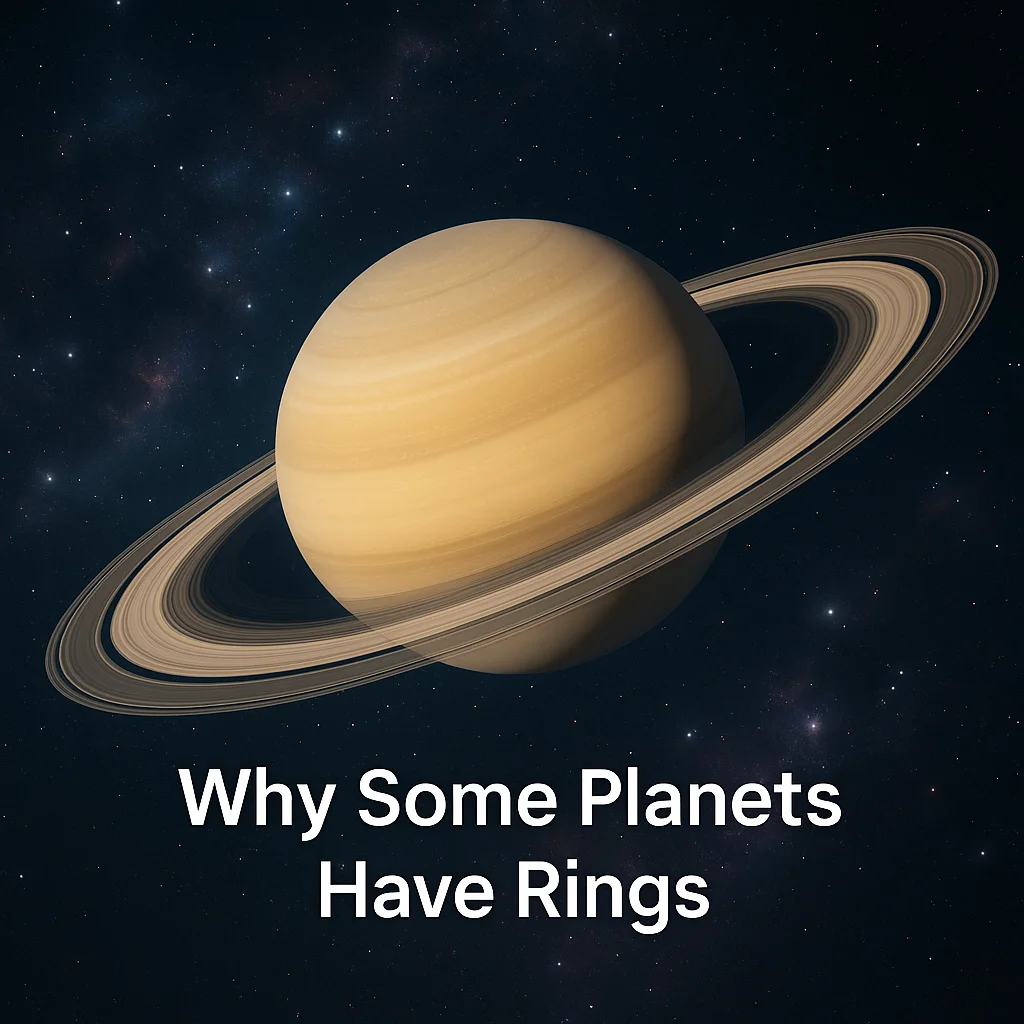
The planets with well-known rings are typically classified as gas giants. These planets, like Jupiter, Saturn, Uranus, and Neptune, are predominantly composed of gas and lacking a solid surface. Saturn is especially famous for its prominent and vivid ring system, which can be easily seen from Earth with a telescope.
This article aims to explore why some of these giant planets have rings while others don't and delve into the characteristics and behavior of these spectacles in space. Whether it's understanding their composition or how they came to be, there's a lot to uncover.
📍 Where It Is and How Far Away
In our solar system, the planets with rings are the outer gas giants located beyond the asteroid belt. Jupiter, Saturn, Uranus, and Neptune all have rings, though they vary significantly in visibility and composition. These planets are much farther from the sun compared to Earth, contributing to their lower temperatures and unique compositions.
To put their distance into perspective, Saturn is approximately 9.5 astronomical units (AU) from the sun. An AU is the average distance from the Earth to the sun, about 93 million miles. This vast distance means that sunlight takes about 80 minutes to reach Saturn.
These great distances also result in much colder environments, which affects how gases, liquids, and ices behave in the outer solar system. The conditions out here contribute to the formation and maintenance of ring systems around these giant planets.
🧱 Size, Mass, and Gravity (Made Simple)
Gas giants like Saturn and Jupiter are much larger and more massive than Earth. For instance, Saturn's diameter is about 9 times that of Earth's, and it has over 95 times the mass. Yet, due to its gaseous nature, Saturn's surface gravity is slightly weaker than Earth's, meaning you would feel lighter if you could stand there.
However, gas giants do not have a definitive solid surface like Earth. Instead, their composition transitions from gas to liquid and eventually to dense cores. This means "standing" on these planets is an abstract idea, as there is no solid land beneath their atmospheres.
🌡️ Atmosphere and Weather
The atmospheres of gas giants are composed mainly of hydrogen and helium, similar to the sun. They're known for having thick cloud layers and dynamic weather systems. For instance, Saturn features high-speed winds reaching up to 1,100 miles per hour, contributing to its banded appearance.
These environments host complex weather patterns driven by internal heat rather than sunlight. In fact, Saturn emits more heat than it receives from the sun, which supports the formation of storms and wind currents in its atmosphere.
Understanding the weather on these planets is quite different from Earth’s, as their weather isn't influenced directly by solar energy but by their internal processes and high rotational speed.
🪨 Surface and Interior
Given that gas giants lack a solid surface, describing their interior involves understanding their atmospheric layers. As you move deeper, you'll encounter increasing pressure and temperature, with gases transitioning into liquids.
The cores of these planets are believed to consist of rock and metal under immense pressure. Above the core, thick layers of metallic hydrogen exist, a form of hydrogen that behaves like a metal due to extreme conditions.
This internal structure, although fluid and dynamic, is key to understanding the planets' magnetic fields and other observable phenomena like their rings and moons.
🌀 Rotation, Orbit, and Seasons
Gas giants like Jupiter and Saturn rotate rapidly. Saturn, for example, has a day lasting only about 10.7 hours. This fast rotation flattens the planet slightly at the poles and contributes to its strong magnetic field and dynamic weather systems.
The orbit of these planets around the sun is much longer than Earth’s. Saturn takes about 29.5 Earth years to complete one orbit, leading to long seasons. The planet's axial tilt causes seasonal changes in the appearance of its rings.
🧲 Magnetic Field and Radiation
The magnetic fields of gas giants are strong and complex. Saturn, for instance, has a strong magnetic field generated by the motion of metallic hydrogen deep within. This magnetic field traps charged particles, creating radiation belts around the planet.
The interactions between these magnetic fields and solar wind can result in beautiful auroras at the poles, much like Earth's northern lights. Additionally, the presence of magnetic fields plays a crucial role in maintaining ring materials within their orbits.
🌙 Moons, Rings, and Neighbors
Saturn's rings are the most iconic, composed mostly of ice particles, with some rocks and dust. They are held in place by the planet's gravity and the gravitational influences of its many moons, known as shepherd moons.
These moons help keep the rings stable, and their interactions can form gaps within the rings or cause them to have distinct shapes. The presence of rings is influenced by a balance of gravitational forces and the material available, often thought to be remnants from moons or other bodies that broke apart.
While Saturn's rings are the most visible, other gas giants like Jupiter and Neptune also possess ring systems, though they are fainter and less studied.
🔭 How We Know (Missions and Observations)
Astronomers learn about planets with rings using telescopes and spacecraft. Observations from Earth-based telescopes provide initial views, while missions like Voyager, Cassini for Saturn, and Galileo for Jupiter offer detailed data.
These missions have captured images and gathered data on gravitational fields and electromagnetic spectra, helping scientists understand ring composition and behavior. Spacecraft like Cassini have even flown through ring systems, offering remarkable close-up observations.
❓ Common Questions and Misconceptions
Many people ask why these planets have rings in the first place. Rings might form from debris left over from the planet's formation or from moons that broke apart.
Another common question is whether you could stand on a gas giant. Not in the traditional sense! Without a solid surface, there's nothing to stand on. The gases become liquid and denser as you go deeper.
Some think these rings are very thick, but they’re quite thin, only about a few kilometers thick, though they can be hundreds of thousands of kilometers wide.
People also wonder if Earth could have rings. It’s unlikely now but theoretically possible if Earth experienced the right asteroid collisions or moon breakups.
Lastly, it's frequently asked if these ring systems change. Indeed, they do! The gravitational influences from moons and other bodies continuously reshape them.
📌 Summary
- Some planets have rings composed mainly of ice, rock, and dust.
- These planets are Jupiter, Saturn, Uranus, and Neptune, located far from the sun.
- Gas giants are massive but lack solid surfaces; gravity varies from Earth's.
- Their atmospheres are mainly hydrogen and helium, with extreme temperatures and winds.
- No solid surface; interior consists of gas, liquid, and dense cores.
- Rapid rotation, long orbits, and varying axial tilts affect seasons and ring appearances.
- Strong magnetic fields influence auroras and radiation belts.
- Rings held by gravity and moons; Saturn's are the most visible.
- We learn through telescopes and missions like Voyager and Cassini.
- Unique patterns and materials offer a cosmic dance of changing shapes.