🪐 Inclination and Eccentricity Explained
🌌 What It Is
Inclination and eccentricity are two critical terms used by astronomers to describe the orbits of celestial bodies. Inclination refers to the tilt of an object's orbit relative to a defined plane, usually the plane of the Solar System known as the ecliptic. On the other hand, eccentricity measures how much an orbit deviates from being a perfect circle.
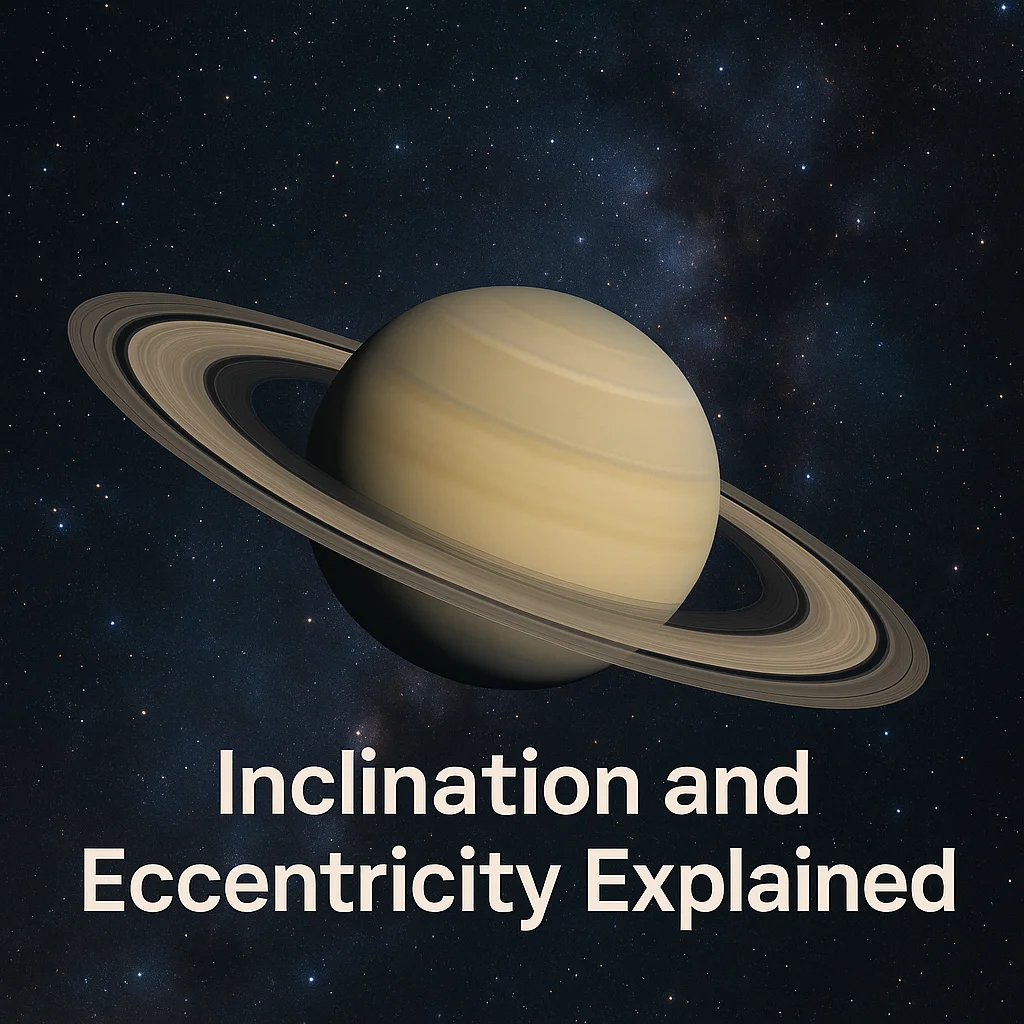
These concepts help scientists categorize and understand how planets, asteroids, and other objects move through space. Understanding inclination and eccentricity allows us to predict future positions of these bodies and comprehend their past movement throughout the cosmos.
In this article, we'll guide you through what inclination and eccentricity mean for planets and how these concepts are applied in understanding planetary orbits. By the end, you'll have a basic grasp of how these factors affect the movement and classification of celestial bodies.
📍 Where It Is and How Far Away
In the context of our Solar System, inclination and eccentricity are critical for determining the orbits of planets and other celestial bodies. These orbits are all centered around the Sun, with varying distances and tilts. The unit typically used for measuring distances in space is the Astronomical Unit (AU), which is the average distance from the Earth to the Sun, about 93 million miles or 150 million kilometers.
The eccentricity of an orbit determines how elliptical it is. An eccentricity of 0 means a perfectly circular orbit, while values closer to 1 describe more elongated paths. Most planetary orbits in the Solar System have low eccentricities, indicating that they are nearly circular. This near-circular motion ensures a relatively steady distance from the Sun, influencing the amount of sunlight and heat they receive.
Inclination affects how much a planet's orbit deviates from the plane of the ecliptic. The higher the inclination, the more "tilted" the orbit. This tilt affects how the planet moves through space relative to other bodies orbiting in the same system.
🧱 Size, Mass, and Gravity (Made Simple)
While inclination and eccentricity don't directly relate to the size, mass, or gravity of celestial bodies, they are essential for understanding orbital dynamics. The size and mass of a planet, for instance, affect its gravitational pull, which in turn influences its ability to maintain moons or affect other nearby bodies.
The gravity of a planet is a function of its mass and size. A larger or more massive planet will have stronger gravity. For comparison, Earth's surface gravity is what we're used to, while a planet like Jupiter—with its more massive size—has surface gravity over 2.5 times stronger. This means objects weigh more and would feel "heavier" on Jupiter than on Earth.
Understanding these physical properties helps scientists predict how a planet's gravity influences its orbit, as well as those of any moons or nearby asteroids. However, the actual calculation of inclination and eccentricity involves precise measurements beyond just mass and size.
🌡️ Atmosphere and Weather
The atmosphere and weather patterns of different planets can be influenced by their inclination and eccentricity. For instance, a planet with a high eccentricity may experience extreme temperature variations during its orbit due to its varying distance from the Sun. On Earth, the moderate eccentricity and tilt influence the changing seasons.
Atmospheres are composed of various gases, and their composition can change how heat is trapped or released, impacting weather and climate. For instance, Venus has a thick, carbon dioxide-rich atmosphere that traps heat, leading to surface temperatures hotter than Mercury, despite its farther distance from the Sun.
The inclination of a planet can also have an impact on climatic conditions over long periods. A high inclination might result in seasonal variations at the poles, comparable to Earth's axial tilt which causes seasons by variably exposing different hemispheres to sunlight.
🪨 Surface and Interior
In rocky planets, the surface is often shaped by factors like tectonics, volcanism, and impacts from space debris. For instance, Mars showcases vast canyon systems and extinct volcanoes, shaped by its geological activity and past atmospheric conditions.
Gas giants, such as Jupiter and Saturn, lack a true surface. Instead, they have thick atmospheres that transition into ever-denser layers beneath. Their characteristic bands and storms are features of their outer layers and atmospheres.
The inclination of planetary rotation axes compared to their orbital planes can also result in interesting surface effects. Though not directly related, features on a surface may affect measurements and perceptions of inclination when observed from afar.
🌀 Rotation, Orbit, and Seasons
The rotation and orbit of a planet determine the length of its day and year. Earth's rotation takes about 24 hours, creating one day-night cycle, while its orbit around the Sun takes about 365 days, forming a year.
Inclination affects whether a planet experiences distinct seasons. Earth's axis, tilted at about 23.5 degrees, results in varied sunlight exposure over the course of its orbit, causing the seasons. In contrast, Uranus, with an extreme tilt of about 98 degrees, experiences extreme seasons.
Eccentricity impacts how evenly sunlight is distributed throughout the orbit. Although most planets have near-circular orbits, those with more elliptical paths, like some of the dwarf planets, may have more pronounced seasonal changes.
🧲 Magnetic Field and Radiation
The magnetic field of a planet is generated by its interior processes, often linked to its rotation and core composition. Earth has a magnetic field that protects us from solar wind and cosmic radiation, causing phenomena like auroras.
In planets with significant magnetic fields, like Jupiter and Saturn, the effects on radiation belts and space weather are substantial. These fields affect how particles move in space, impacting spacecraft and sometimes creating auroras not unlike those seen on Earth.
Understanding a planet's magnetic field also informs us about its interior, as it's believed these fields are generated by the motion of molten materials within. This offers clues about the planet's composition and thermal dynamics.
🌙 Moons, Rings, and Neighbors
Many planets have moons and ring systems that interact with their gravitational fields. These interactions can be influenced by inclination and eccentricity, as well as by the bodies' proximity to each other.
For example, the moons of Jupiter, especially the Galilean moons, have gravitational effects on their host planet and each other, sometimes creating resonances that affect their orbits. Saturn’s rings, composed of ice and rock particles, are shaped by the gravitational pull of its moons and its own rotation.
Not all planets have moons or rings, which depends on multiple factors including the presence of other large planets nearby or the dynamics of capture during the planet's formation.
🔭 How We Know (Missions and Observations)
Missions to study celestial bodies provide crucial data that shape our understanding of orbits, surfaces, atmospheres, and more. Telescopes observe planets from Earth, analyzing light and other radiation for signs of atmospheric composition or surface features.
Spacecraft missions, such as the Voyager probes or the Mars rovers, gather in-situ data, ranging from gravity measurements to atmosphere analysis. These missions provide a closer look than what's possible from Earth, enabling detailed mapping of inclination and eccentricity among other orbital parameters.
By using both telescopes and spacecraft, we gain a fuller picture of how celestial bodies move and interact, based on observations that cover visual imaging, infrared readings, and electromagnetic field measurements.
❓ Common Questions and Misconceptions
Is inclination the same as tilt? Not exactly. Inclination refers to the tilt of an orbit, while axial tilt refers to the tilt of a planet’s rotation axis.
Can eccentricity make an orbit dangerous? Highly eccentric orbits can cause collision risks if they cross paths with other bodies, but most large bodies have stable orbits.
Do all planets have high inclinations? No, most planets in our Solar System have low orbital inclinations relative to the ecliptic plane.
Is a lower eccentricity always better? Not necessarily; it depends on the stability and environment of the orbit.
Why do Earth and other planets remain in the same plane? Over billions of years, gravitational interactions have largely aligned the planets into a similar orbital plane.
Does inclination affect climate directly? Not directly, but it influences how sunlight is distributed across a planet's surface, affecting climate over time.
📌 Summary
- What it is: Concepts defining orbital shape and tilt.
- Where it is: Applied to celestial bodies in the Solar System and beyond.
- Size/gravity takeaway: Orbits impact by gravity; larger mass affects orbits more.
- Atmosphere/weather: Eccentricity affects temperature stability; inclination alters light exposure.
- Surface/interior: Rocky or gas nature affects how inclination is perceived.
- Orbit/rotation: Influences day-length, year-length, and season pattern.
- Magnetic/radiation: Affected by internal dynamics, pivotal for protection from cosmic forces.
- Moons/rings: Result from complex gravitational relationships due to orbits.
- How we know: Through observatory data and direct mission findings.
- One memorable fact: Earth's moderate eccentricity and inclination enable stable seasons.