🪐 What Is the Kuiper Belt? (Beginner Guide)
🌌 What It Is
The Kuiper Belt is a vast region of space located beyond the orbit of Neptune. It's a collection of icy bodies, remnants from the early days of our solar system. Imagine it as a distant, frozen frontier made up of billions of small celestial objects.
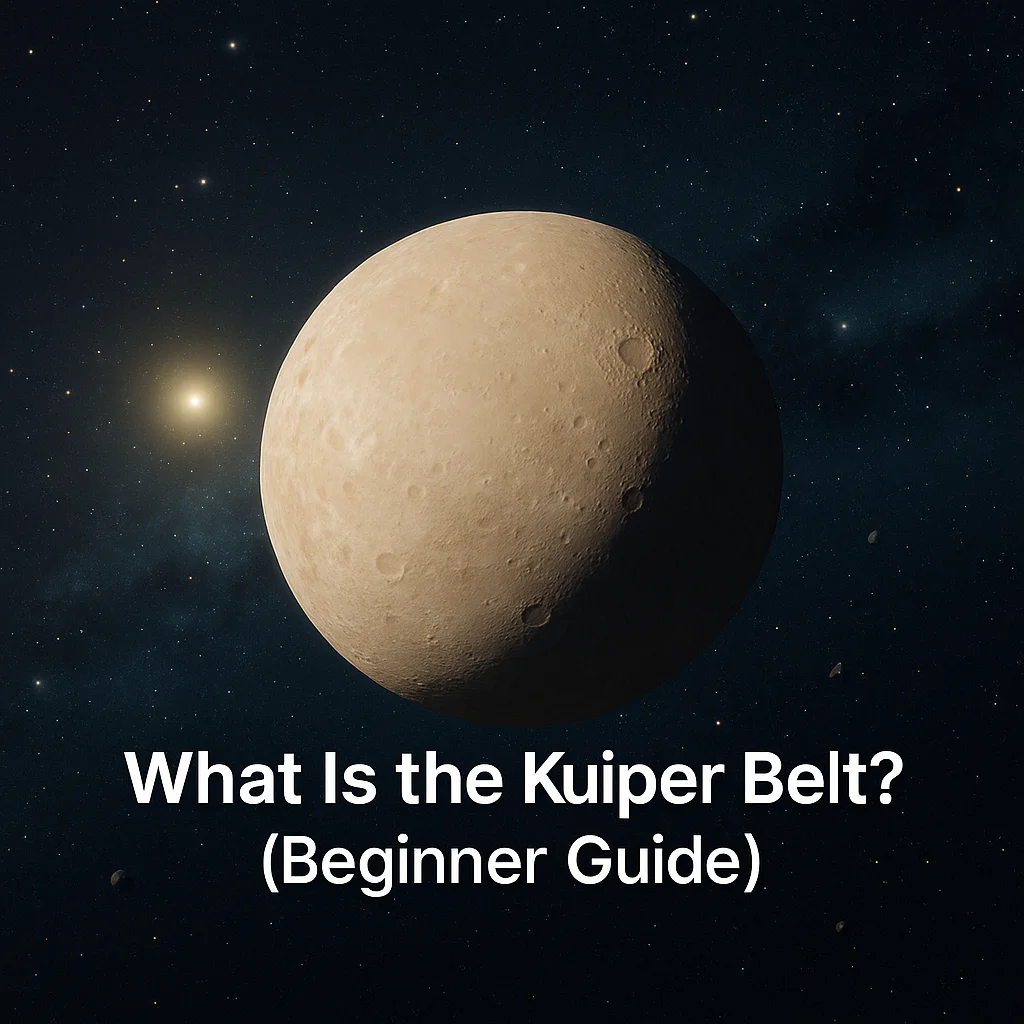
This belt forms a ring-like zone around the Sun, and it's filled with chunks of ice, dust, and rock. These objects are remnants from the solar system's birth. Studying the Kuiper Belt gives scientists insight into how our solar system formed and evolved over billions of years.
In this article, you'll learn about the location, size, and significance of the Kuiper Belt. You'll also explore some of the fascinating features of this distant region and understand how scientists study it from Earth.
📍 Where It Is and How Far Away
The Kuiper Belt is located beyond Neptune, which is the eighth planet in our solar system. It's positioned at a distance of about 30 to 55 astronomical units (AU) from the Sun. One AU is the average distance from the Earth to the Sun, approximately 93 million miles, or 150 million kilometers. So the Kuiper Belt is quite far from us, between 2.8 and 5.1 billion miles away.
Given its location, the Kuiper Belt receives very little sunlight and is extremely cold. Temperatures can plummet to near absolute zero, the point at which atoms almost stop moving entirely. This cold environment preserves the ancient material within the belt, providing a time capsule of the solar system's early days.
Because of its distance, the light from the Sun takes about four to seven hours to reach the Kuiper Belt. This means that any spacecraft sent to this region must be prepared for long travel times and weak solar energy.
🧱 Size, Mass, and Gravity (Made Simple)
The Kuiper Belt is a massive region—it stretches over a distance of about 20 AU. It's not dense like the asteroid belt between Mars and Jupiter. Instead, the objects within it are spread out, with plenty of empty space in between. These objects vary greatly in size, from tiny particles to large bodies like Pluto.
Despite its vast size, the total mass of the Kuiper Belt is only a fraction of Earth's mass. Gravity in this region is weak due to the small size of the objects and the distance from larger planets like Neptune. If you could "stand" on one of these objects, you'd likely feel a very weak gravitational pull.
Most of the Kuiper Belt's objects are too small to have strong gravitational effects on each other. However, the most massive ones can have moons and gravitational influences of their own.
🌡️ Atmosphere and Weather
The Kuiper Belt itself doesn't have an atmosphere or weather in the traditional sense because it is not a single body but a collection of many small objects. Each of these objects may have its own surface conditions and atmosphere, if any.
For instance, Pluto, one of the largest known bodies in the Kuiper Belt, has a thin atmosphere primarily composed of nitrogen, with traces of methane and carbon monoxide. This atmosphere changes with its orbit, freezing onto its surface when it's farther from the Sun.
The weather in the Kuiper Belt is mainly driven by its extreme cold. Because sunlight is weak, there is little energy to drive atmospheric movement or storms, leading to a very static and calm environment.
🪨 Surface and Interior
The surfaces of Kuiper Belt objects are coated with frozen ices, including water, methane, and ammonia, giving them a reflective, icy appearance. Craters and surface features on these objects are shaped by impacts from other small bodies over billions of years.
Pluto provides an excellent case study as a large Kuiper Belt object. It has a diverse landscape with nitrogen ice plains, mountains of water ice, and signs of tectonic activity. The surface variation suggests that these objects might not be geologically dead.
The interiors of Kuiper Belt objects are less understood, but it's believed they are composed of a mix of frozen gases and rocks. Some may have differentiated interiors, with layers of different materials, though this varies based on their individual history and size.
🌀 Rotation, Orbit, and Seasons
The rotation period of Kuiper Belt objects can vary greatly. While Pluto takes about 6.4 Earth days to complete one rotation, other smaller objects may rotate much faster or slower. The rotation affects how sunlight and temperatures vary across their surfaces.
The orbit of these bodies around the Sun is typically long and elliptical. Due to their distance from the Sun, a single orbit can take hundreds of Earth years. For instance, Pluto takes about 248 Earth years to orbit the Sun.
Seasons in the Kuiper Belt, if they exist, are prolonged due to these extended orbits. An object's axial tilt also influences seasonal variations, but given the cold environment, seasonal effects are mostly subtle.
🧲 Magnetic Field and Radiation
Most objects in the Kuiper Belt do not have magnetic fields like larger planets. This is likely due to their small size and lack of internal dynamo processes that generate magnetic fields on planets like Earth.
The absence of a strong magnetic field means that these objects do not have significant radiation belts or protection from cosmic radiation. Spacecraft visiting the Kuiper Belt must be designed to endure increased exposure to radiation.
This lack of magnetic activity means auroras or space weather phenomena are unlikely on most Kuiper Belt objects, making them less dynamic than magnetically active bodies.
🌙 Moons, Rings, and Neighbors
Several large Kuiper Belt objects, such as Pluto, have moons. Pluto has five known moons, with Charon being the largest. The Pluto-Charon system is unique because both bodies are gravitationally locked, showing the same face to each other as they orbit a shared center of mass.
Not all Kuiper Belt objects have moons, but some have small companions or are part of binary systems, where two bodies of comparable size orbit each other. The distribution and study of these moons help scientists understand gravitational interactions in this distant region.
Rings are not commonly associated with Kuiper Belt objects, unlike giant planets such as Saturn. However, interactions and collisions within the belt could theoretically create temporary rings or debris fields.
🔭 How We Know (Missions and Observations)
Telescope observations from Earth and space have provided much information about the Kuiper Belt. These telescopes can capture images, spectral data, and motion studies to learn about the composition and orbits of Kuiper Belt objects.
The most notable spacecraft mission to the Kuiper Belt is NASA's New Horizons. This mission provided the first close-up images and data of Pluto and its moons. After visiting Pluto, New Horizons continued into the Kuiper Belt to study other objects.
Data collected from missions like New Horizons, alongside ground-based telescopic studies, continue to enhance our understanding of these distant objects, offering clues about the evolution of the outer solar system.
❓ Common Questions and Misconceptions
Is it a star? No, the Kuiper Belt is not a star; it's a region full of icy bodies.
Can you stand on it? You cannot stand on the Kuiper Belt as a whole; it's not a single surface but a collection of many objects.
Is it habitable? The Kuiper Belt is too cold and lacks conditions necessary for life as we know it.
Why is it that color? The color of Kuiper Belt objects can vary, often appearing reddish or white due to icy surfaces and organic compounds.
Does it affect Earth's climate? The Kuiper Belt has no significant impact on Earth's climate.
Is Pluto still a planet? Pluto is classified as a dwarf planet, which means it's not considered one of the eight main planets in our solar system.
Are there unknown planets beyond it? Scientists theorize about potential "Planet Nine" but have not confirmed any beyond the Kuiper Belt.
Is it like the asteroid belt? It's similar in that it's a collection of objects, but the Kuiper Belt is much larger and contains more ice than the asteroid belt.
📌 Summary
- The Kuiper Belt is a region beyond Neptune filled with icy objects.
- It stretches from about 30 to 55 AU from the Sun.
- It is vast with weak gravity due to the small size of its objects.
- Objects may have thin atmospheres; the region is very cold.
- Surfaces are icy, with diverse landscapes and craters.
- Orbits are long, with rotations varying widely among objects.
- Most objects do not have significant magnetic fields.
- Some objects have moons; rings are rare.
- Study is through telescopes and missions like New Horizons.
- Captures the early solar system with fascinating frozen relics.