🪐 What Is the Oort Cloud?
🌌 What It Is
The Oort Cloud is a vast, spherical shell surrounding our Solar System, filled with icy bodies and cometary material. This cloud is thought to be the source of many comets that travel into the inner Solar System, providing a distant reservoir of icy debris. Unlike planets, the Oort Cloud is not a singular object but rather a collection of numerous small entities.
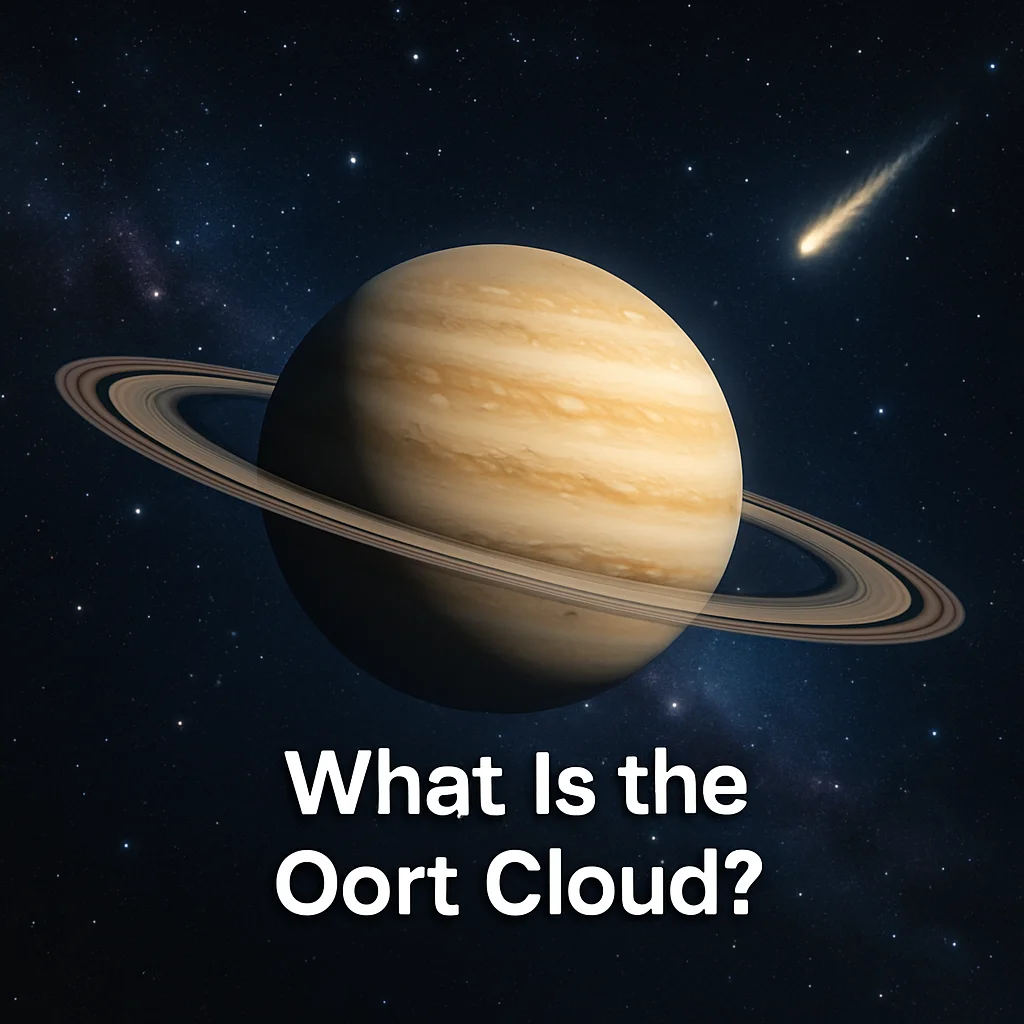
Understanding the Oort Cloud helps scientists learn about the early Solar System's formation and the outer reaches beyond the known planetary bodies. It represents the boundary between our Solar System and the vast interstellar space beyond it.
In this article, readers will discover what the Oort Cloud is, where it is located, its size, and its significance for understanding comets and the edge of our Solar System. We'll also cover how scientists study such a distant and largely unseen structure.
📍 Where It Is and How Far Away
The Oort Cloud is situated at the outermost edge of our Solar System, far beyond the orbits of the planets and even the Kuiper Belt. It starts roughly at a distance of 2,000 to 5,000 astronomical units (AU) from the Sun and extends out to about 100,000 AU. One AU is the average distance from the Earth to the Sun, approximately 93 million miles or 150 million kilometers.
At such distances, the Oort Cloud is incredibly far from the Sun, making its components extremely cold due to the minimal sunlight they receive. It is located in the realm where the Sun's influence wanes, and objects can be more easily perturbed by the gravitational forces of nearby stars.
This location is so distant that it takes light from the Sun nearly a year to reach the outer regions of the Oort Cloud, highlighting just how far this mysterious region is from the Earth and inner planets.
🧱 Size, Mass, and Gravity (Made Simple)
The Oort Cloud is enormous, spanning from about 2,000 AU to 100,000 AU from the Sun, which makes it roughly a spherical boundary encasing the Solar System. Despite its vast size, the Oort Cloud does not have significant mass due to the small and scattered nature of its icy bodies.
Because the Oort Cloud consists of countless small icy objects, the overall gravitational influence is weak compared to the gravitational forces exerted by planets. Standing in the Oort Cloud, hypothetically, would feel like floating in a desolate and sparsely populated realm of ice and rock.
This lack of solid surface and the small size of its components mean that gravity's pull within the Oort Cloud would be nearly negligible compared to the experience of standing on a planet like Earth.
🌡️ Atmosphere and Weather
Unlike a planet or moon, the Oort Cloud does not have an atmosphere. Instead, it is composed of icy bodies that may produce thin atmospheres called comas when they are nudged toward the Sun. As these objects get closer to the Sun, they can develop tails and comas, which are temporary atmospheres made up of outgassed water vapor and dust.
The "weather" in the Oort Cloud is not akin to what we experience on planets. It involves interactions with solar and cosmic radiation as comets approach the Sun, triggering sublimation of ice. These activities are driven primarily by chemical composition and proximity to the Sun.
Due to its cold and distant position, the Oort Cloud's constituents remain largely inactive, only displaying dynamic behavior under specific circumstances, like when perturbed into the inner Solar System.
🪨 Surface and Interior
The components of the Oort Cloud are icy bodies, some as small as a few meters wide, while others might reach the size of small mountains. These bodies are composed of water ice, frozen gases, and rock, similar to the nuclei of comets that we observe when they approach the Sun.
Each object within the Oort Cloud lacks a solid surface as planets have. Instead, they are frozen remnants from the early Solar System, preserving the primordial materials in their interiors.
Although their interiors are not well-studied, understanding the composition of these objects provides insight into the original building blocks of the Solar System.
🌀 Rotation, Orbit, and Seasons
Objects within the Oort Cloud orbit the Sun, albeit in highly elongated and distant paths, taking thousands to millions of years to complete a single orbit. These orbits do not lead to the kind of seasonal changes we see on Earth.
The rotation of individual Oort Cloud objects is varied, with each object spinning on its own axis at different rates. These rotations are likely slow, reflective of the calm and isolated environment of the Oort Cloud.
Due to the vast distances and unique orbital paths, the concept of seasons is not applicable to the Oort Cloud, which remains in a cold, unchanging state over most of its extent.
🧲 Magnetic Field and Radiation
The Oort Cloud itself does not generate a magnetic field like planets with metallic cores do. However, its constituents might interact with solar wind and cosmic particles, especially when closer to the Sun.
These interactions can generate temporary magnetic effects in the form of comas or ion tails around active comets that venture into the sunlit parts of the Solar System.
Radiation in the Oort Cloud is primarily from distant starlight and cosmic rays, with less influence from the Sun due to the significant distance.
🌙 Moons, Rings, and Neighbors
The Oort Cloud does not have moons or rings like the outer planets but acts as the ultimate boundary of the Solar System. Its neighbors are the stars and their own cometary clouds that lie beyond our Solar System.
Gravitational interactions with other stars can perturb Oort Cloud objects, sending them toward the Sun and making them visible as long-period comets. These interactions highlight the dynamic relationship between the Oort Cloud and the broader galaxy.
The lack of moons and rings aligns with the Cloud's nature as a collection of individual bodies rather than a cohesive orbits or systems seen in planetary contexts.
🔭 How We Know (Missions and Observations)
Most information about the Oort Cloud comes from indirect observations, like tracking cometary paths. Spacecraft missions, such as those aimed at observing the outer planets, provide crucial data but have not reached the Oort Cloud.
Observations from telescopes on Earth and in space help scientists study the light reflected off comets, providing insights into their composition. Although no direct missions to the Oort Cloud exist, future projects could enhance understanding.
Data from these observations include images, spectra revealing chemical makeup, and measurements of changes in comet paths that suggest distant gravitational forces.
❓ Common Questions and Misconceptions
Is the Oort Cloud a planet? No, it's a vast collection of icy bodies and not a planet.
Can you stand on the Oort Cloud? No, it's made of many small, scattered objects with no solid surface.
Is it habitable? No, it's too cold and lacks an atmosphere for life as we know it.
Why is it important? It helps us understand the origins of comets and the Solar System's formation.
Is it a star? No, the Oort Cloud is not a star; it's a cloud of icy debris.
Does it have rings? No, unlike planets, it does not have rings.
Can we see it? The Oort Cloud is too distant to see directly with current technology.
Are Oort Cloud comets dangerous? Occasionally, comets may pose a threat if their paths intersect with Earth, but this is rare.
Does the Oort Cloud affect Earth? It indirectly affects Earth by supplying comets that may be visible or impact the planet.
📌 Summary
- The Oort Cloud is a distant, spherical shell of icy bodies surrounding our Solar System.
- It is located roughly 2,000 to 100,000 AU from the Sun, far from the planets.
- The Oort Cloud is vast but comprised of widely scattered and small objects, meaning weak gravity.
- It has no atmosphere but affects comet atmospheres when objects enter the inner Solar System.
- Comprised of icy and rocky bodies, Oort Cloud objects do not have solid, recognizable surfaces.
- With slow orbits and rotations, it remains in a cold, unchanged state without seasons.
- Absent a magnetic field, interactions with solar wind may occur around active comets.
- No moons or rings exist; gravitational interactions with stars can alter its contents' orbits.
- Studied through telescope observations and comet tracking, future missions may improve understanding.
- It explains the origins of comets and the boundary of the Solar System.