🪐 Asteroids Explained Simply
🌌 What It Is
Asteroids are small rocky bodies that orbit the Sun, primarily found in a region known as the asteroid belt between the orbits of Mars and Jupiter. Unlike planets, they are not spherical and can have irregular shapes due to their relatively small masses.
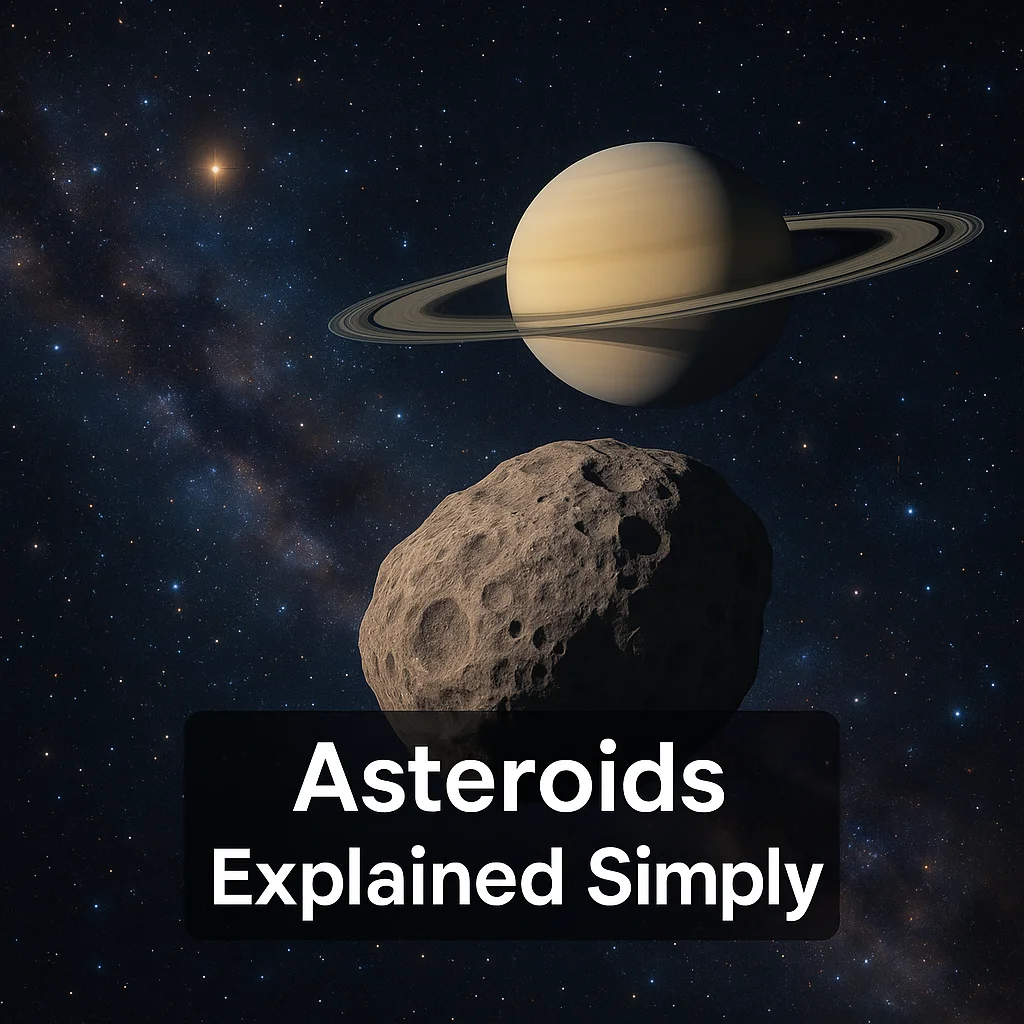
Asteroids serve as remnants from the early solar system, offering insights into the building blocks of our cosmic neighborhood. Scientists study asteroids to understand the conditions and materials that coalesced to form planets.
In this article, you will learn about the location, composition, and other fascinating characteristics of asteroids, including their role in our solar system and how we gather information about them.
📍 Where It Is and How Far Away
The majority of asteroids are located in the asteroid belt, a vast area in space between Mars and Jupiter. This region hosts thousands of these rocky objects, which vary greatly in size and composition. However, some asteroids, known as Near-Earth Asteroids, travel close to our planet's orbit.
To put this into perspective, the average distance from Earth to the asteroid belt is, on average, about 2 to 3 Astronomical Units (AU). One AU is the mean distance from the Earth to the Sun, approximately 93 million miles or 150 million kilometers.
Asteroids in the belt generally receive less sunlight than Earth due to their average distance from the Sun. As a result, they experience cooler temperatures, contributing to their predominantly rocky compositions.
🧱 Size, Mass, and Gravity (Made Simple)
Asteroids can range tremendously in size, from tiny pebbles to bodies that are hundreds of kilometers across. The largest asteroid, Ceres, is about 940 kilometers (or 584 miles) in diameter, though most are much smaller.
The mass of an asteroid affects its gravity, which is typically very weak compared to Earth's. You could jump significantly higher on a small asteroid due to its low gravitational pull. Unlike planets, standing on an asteroid could feel strange because the gravity is so minimal.
🌡️ Atmosphere and Weather
Asteroids do not have atmospheres like Earth. Their low gravity means they cannot hold onto significant amounts of gas, so there is no weather as we experience it.
Without an atmosphere, asteroids face the full brunt of solar radiation and cosmic rays. Their surfaces can heat up during the daytime and cool down rapidly at night, creating extreme temperature variations.
🪨 Surface and Interior
The surfaces of asteroids are diverse but typically marked by craters and rocky terrain, shaped largely by past collisions with other celestial objects. These impacts reveal the asteroid's composition, providing valuable scientific data.
Their interiors are believed to be either solid rock or a "rubble pile" consisting of numerous smaller boulders held together by gravity. Asteroids lack molten cores like Earth; most are considered quite ancient and unchanged since they formed.
🌀 Rotation, Orbit, and Seasons
Asteroids exhibit a wide range of rotation periods; some spin rapidly within a few hours, while others rotate slowly over days. The length of an asteroid's day can vary significantly based on its rotational speed.
Asteroids orbit the Sun on elliptical paths. Depending on their tilt, they may not experience seasons in the same way planets do. Instead, their irregular shapes and spins can lead to complex patterns of sunlight and shadow over their surfaces.
🧲 Magnetic Field and Radiation
Most asteroids do not possess a magnetic field, unlike planets such as Earth. Without a magnetic field, their surfaces are more exposed to cosmic radiation and solar winds.
This exposure can strip away any slight atmosphere or gases present and can also impact the surfaces of spacecraft exploring asteroids, requiring additional protections.
🌙 Moons, Rings, and Neighbors
Some asteroids have small moons orbiting them, formed likely by debris from past collisions. For example, the asteroid Ida has a tiny moon named Dactyl.
Typically, asteroids do not have rings, and they interact gravitationally with neighboring asteroids, occasionally resulting in collisions or changes in their trajectories.
🔭 How We Know (Missions and Observations)
Astronomers use telescopes and space missions to study asteroids. Ground-based telescopes can observe their brightness, position, and occasionally their shape through radar imaging.
Several spacecraft have visited asteroids, such as NASA's OSIRIS-REx, which collected samples from the asteroid Bennu. These missions provide detailed images and data on asteroid compositions, textures, and orbits.
❓ Common Questions and Misconceptions
Is an asteroid a planet? No, asteroids are much smaller and often irregular in shape compared to planets.
Can you stand on an asteroid? Yes, but you would experience very low gravity, making each step feel quite different than on Earth.
Are asteroids habitable? No, they lack atmospheres and essential conditions for life as we know it.
Why are asteroids that color? Their colors depend on their surface compositions, often reflecting their silicate and metallic content.
Could an asteroid hit Earth? While possible, astronomers closely track near-Earth asteroids to predict their paths and assess any risk.
Do asteroids have volcanoes? No, asteroids lack the necessary internal heat and geological activity for volcanoes to form.
📌 Summary
- Asteroids are rocky bodies orbiting the Sun, mainly found in the asteroid belt.
- Located primarily between Mars and Jupiter, some get close to Earth.
- Small size and mass lead to low gravity; you could jump high on an asteroid.
- No atmosphere means no weather; extreme temperature changes are common.
- Surfaces marked by craters; interiors can be solid or "rubble piles."
- Rotation periods vary widely, affecting day and shadow patterns.
- Lack of magnetic fields exposes them to cosmic radiation and solar wind.
- Some have small moons; few interactions can lead to collisions or changes.
- Telescopes and missions provide valuable data and samples from asteroids.
- Memorable fact: Ceres is the largest asteroid, nearly a planet due to its size.